Click here to see the Catalog of the 2004 compact show
Click here to see other details about Italian 800 compacts

By
Noelle Soren
http://www.silvercollection.it/SILVERSMITHSFI1.html
http://collectingvintagecompacts.blogspot.com/2010/10/italian-enamelled-compacts-modern-cases.html
http://collectingvintagecompacts.blogspot.com/
Many thanks to Mike for valuable information on compact /painting comparisons!
************
 New items under Jan Baptiste Camille Corot, Jan Havickszoon Steen, Jean Frederic Schall, Sir Thomas Gainsborough, Gaetano Chierci, Leonardo DaVinci, Paolo Veronese, Juan Pablo Salinas y Teruel, Nicolas Lancret, Elisabetta Sirani, Guido Reni, Jean-Antoine Watteau, Jean-Honoré Fragonard,
Elizabeth Louise Vigée-LeBrun
New items under Jan Baptiste Camille Corot, Jan Havickszoon Steen, Jean Frederic Schall, Sir Thomas Gainsborough, Gaetano Chierci, Leonardo DaVinci, Paolo Veronese, Juan Pablo Salinas y Teruel, Nicolas Lancret, Elisabetta Sirani, Guido Reni, Jean-Antoine Watteau, Jean-Honoré Fragonard,
Elizabeth Louise Vigée-LeBrun
NOTE: Regarding the Italian 800 compacts, all lozenge numbers are followed by FL unless otherwise noted.
**********
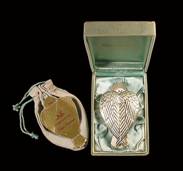
There are many compacts that we might have in our collections that everyone would consider as works of art…Like this Bird-in Hand designed by Salvator Dali…
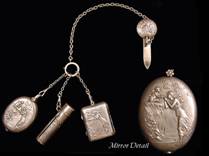
Or this repoussé chatelaine by noted French medal maker Emil Dropsy…
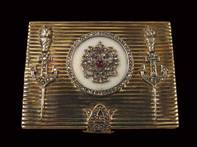
Or this Russian Imperial beauty from the
workshop of Carl Fabergé…
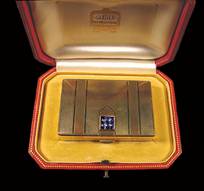
Or this gold, diamond
and sapphire vanity by Cartier, made for Jesse Donahue, the heir to the
Woolworth fortune…
Or
this minaudiére and matching compact by Judith Lieber…
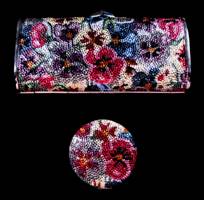
But there is also a
category of compacts made of up those which depict actual worksof
art in miniature. Many of these are from the type known as
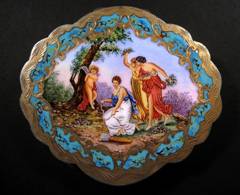
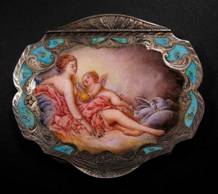
I believe they were
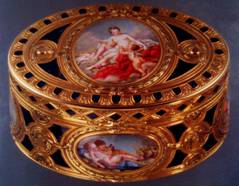
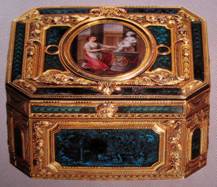
inspired by French snuff boxes of the 17th and 18th centuries like
these (below) I recently saw at the Wallace Collection in
As an archaeologist, art historian and photographer, I work
in
•
Except for a few made by the Fallaci
family just before World War II, they were made from 1946 to about 1970 as a
post-war industry by several Florentine families.
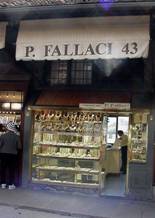
The site of the Fallaci family business today
in
•
At first they were only made of silver and
heavily engraved, but by the 1950s enamel scenes were added. Later gold plated
brass compacts (not marked 800) were added to the mix.
•
Almost none of these were sold in
•
In their last catalogue, in 1970, the Fallaci family was selling their nicest ones for about $77
US.
•
Each phase of the manufacture (the casting,
engraving, enameling, painting, mirror making and firing) was done by a
different artisan, all of whom remain anonymous. Sometimes the matriarchs of
the families did the actual drawing of the scenes and painting, but no one
remembers the names of the other artisans today.
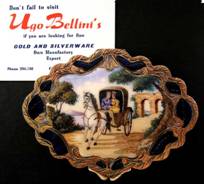
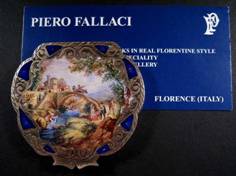
...................................A compact designed by Ugo Bellini .... A signed Fallaci
probably painted by Ottavina
Fallaci, the wife of ..........................................................................Alfredo, the founder of the business.
So, as a life-long lover of
But first, a note about quality.
There are four things I look for when I consider purchasing any scenic compact:
Condition, rareness of the scene, the skill of the painter in capturing detail
and nuance and the quality of the engraving. These are personal preferences of
mine and may or may not be important to other collectors.
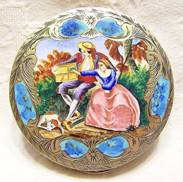
So which is the
better choice for your compact investment? This, where the
figures are clumsily done without shading or detail and the engraving is
amateurish…
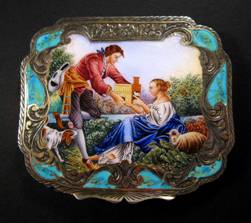
Or this where the
shading of the skin and folds of the clothing are beautifully done within a skillfully done engraved frame…
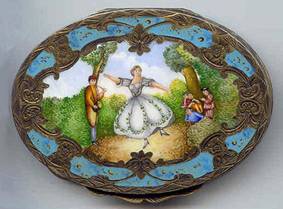
This, where the
figures are little more than cartoons in a scene that lacks even shadows to give them substance…
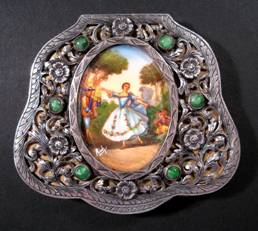
Or this, a much more
faithful representation of the actual painting with skillfully done details, background and shading on the figures and their
clothing…
This, where the
figures, though skillfully done, are lifted from the actual work without the background of the original painting…
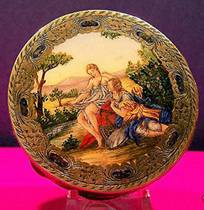
Or this, where the
entire central part of the painting is skillfully reproduced…
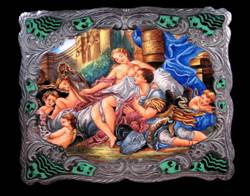
This, where the scene
is little more than an impression of the actual work, withlittle detail in the figures faces and lumps of color where actual drawing should be…
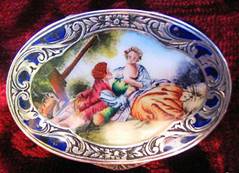
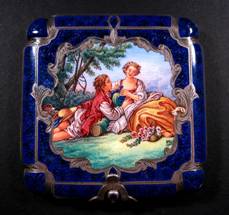
Some works of art that inspired compact
designs were easy to find
– like
this representation on a fine Austrian compact of Sir Thomas Gainsborough’s Blue
Boy , English portraitist (1770) ….
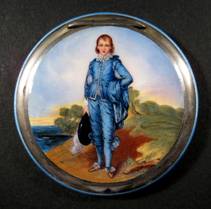
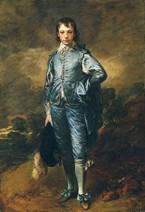
(see also below under Gainsborough for other examples of paintings by this artist)
…or this representation
by Mondaine of Leonardo da
Vinci’s Mona Lisa(La Gioconda or Portrait of Lisa Gherardini), Italian Renaissance
(1503-1506)…
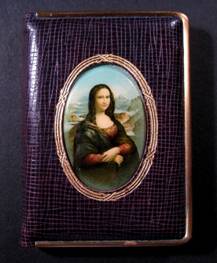
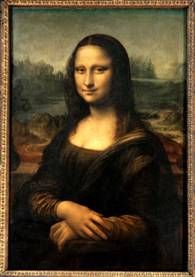
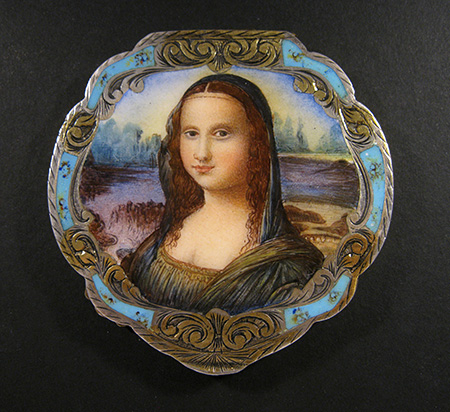
or this beautiful Iitalian 800 example marked HANDMADE ITALY and FALLACI FIRENZE with and illegible lozenge
…or this,
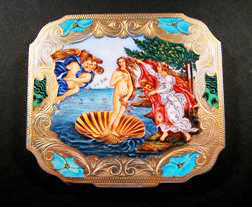
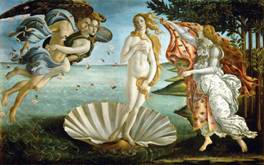
The Birth of Venus by Allesandro
Botticelli, Italian Renaissance (1482-1486) marked 800, illegible in lozenge, 7 in powder well …
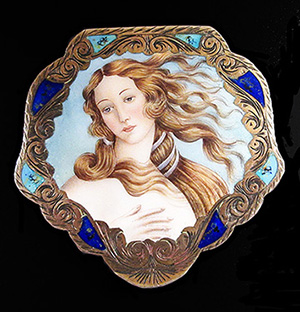
And another marked 800, 190 in lozenge and 11 in powder well
But others were harder to find.
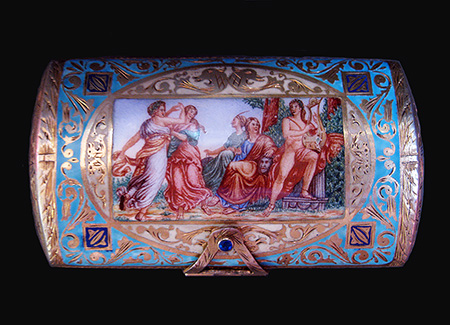
What follows will take just a few minutes for you to read but, in some cases, working with only the style and subjects depicted and without knowing the identity of the artist, it has taken me years to find the comparisons. Perhaps as collectors you will have some of these scenes in your collections. Some of you may have wondered about their origins, so I hope you will find this information useful… (in alphabetical order by artist)
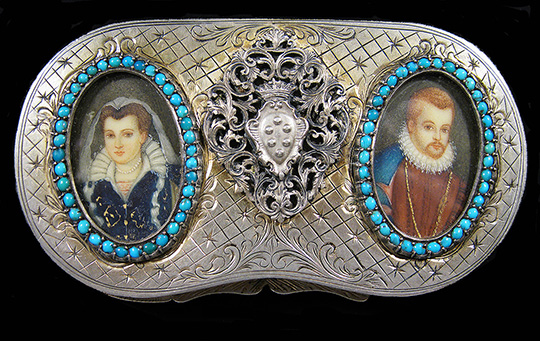
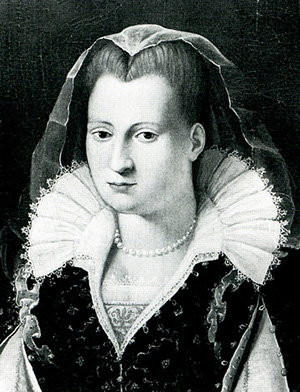
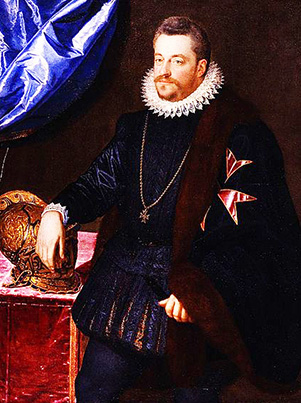
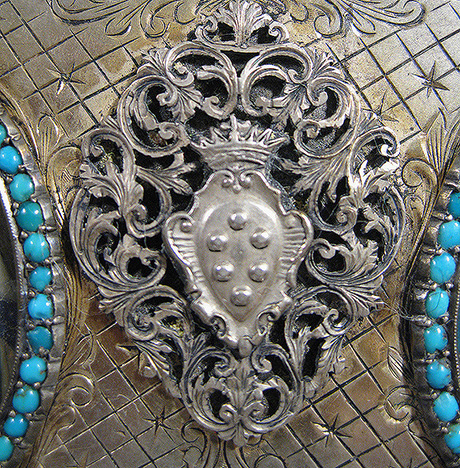
Many thanks to Mike Hetherington for attributions and information concerning this extraordinary compact. Compact with portraits of Isabella de Medici by the workshop ofAlessandro Allori (late 16th c.) and her brother Ferdinando de Medici, Grand Duke of Tuscany by Scipione Pulzone (1590), marked 800, Italy with a fleur-de-lys mark. Isabella de Medici (1542) was Cosimo de Medici's fourth child, and Ferdinando was his tenth born 1549. Between the portraits is a variation of the crest of the Medici family depicting 5 palle or balls which some think represent medicinal pills recalling the family's origins as doctors or apothecaries. The crest is topped with the distinctive pointy crown of the Grand Duchy of Tuscany. This compact probably dates prior to 1934 when the numerical markings used by artisans began in Italy. The fleur-de-lys, a symbol for the city of Florence, may signify the city or may be the mark of a particular artisan. The reason for depicting this distinguised brother and sister pair of the 16th century is unknown. Perhaps the Medici family commissioned this compact to commemorate something important to them.
 ..
..
 ..........................................
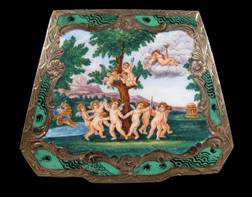
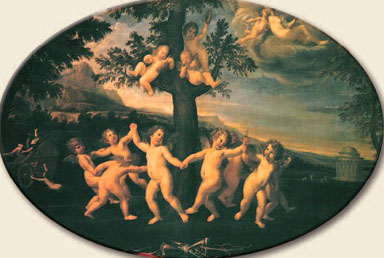
Amorini Celebrating the Rape of Proserpina or The Cupids Dance, by Francesco Albani, Italian Baroque (ca. 1600) marked 800, _1 or 1 in lozenge, 6 in powder well. The story of Proserpina is a seasons myth. Kidnapped by Pluto, god of the underworld, she must spend half the year in the underworld and half on earth. Her return marks the beginning of Spring. In this case the copyist took the subject from the engraver who had taken the subject from the painter!
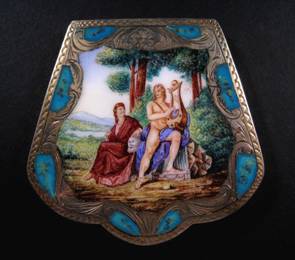
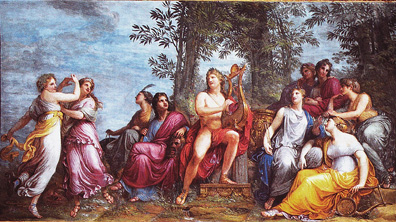
Parnassus by Andrea Appiani (From a fresco in Milan, Italy -1811) marked 800, 304 in lozenge, 12 in powder well.
 ............
Another with the same scene - a rare bolster shape marked 800, 220 in lozenge with a swan...
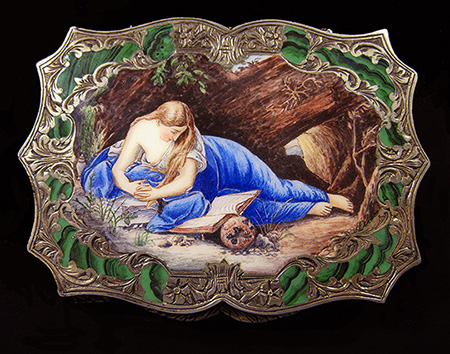
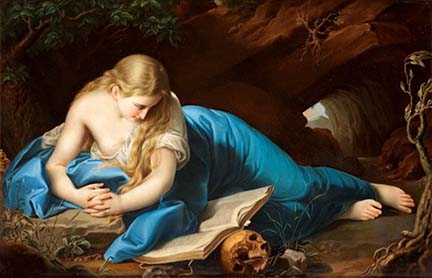
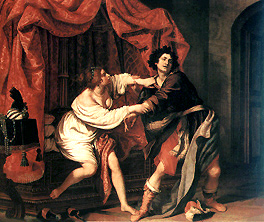
Meditation or the Penitent Magdalene (1742) by Pompeo Girolamo Batoni, marked 800, Made in Italy. Many thanks to Mike Hetherington for this ID.
 .....................
 .......
 ........................
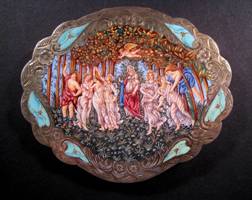
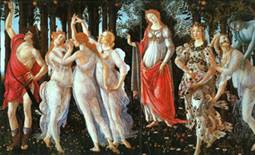
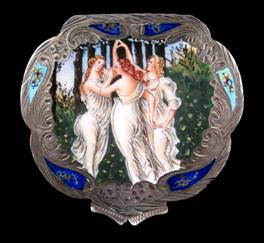
Primavera marked 800, _1 or 1 in lozenge, 7 in powder well, and The Three Graces by Allesandro Botticelli, Italian Renaissance (1482).In this case, just a portion of the painting Primavera was used for the Three Graces marked 800, 117 in lozenge, 20 in powder well. . (See above for the Birth of Venus comparison)
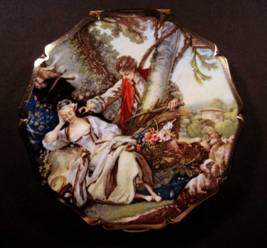
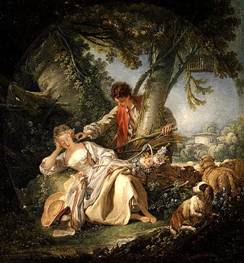
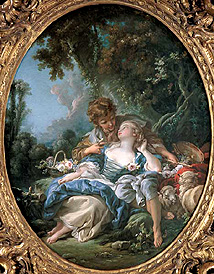
The Sleeping Shepherdess by François Boucher, French Rococo (ca. 1740) on a fine Austrian compact…
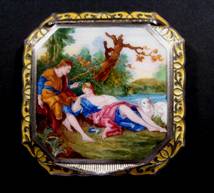
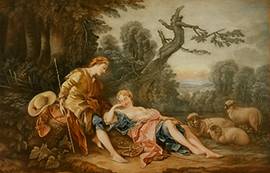
Another version of François Boucher's Sleeping Shepherdess (1740) marked 800, Fallaci Firenze,390 in lozenge, on a jewelled beauty...
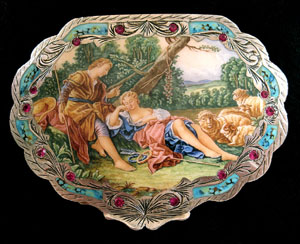
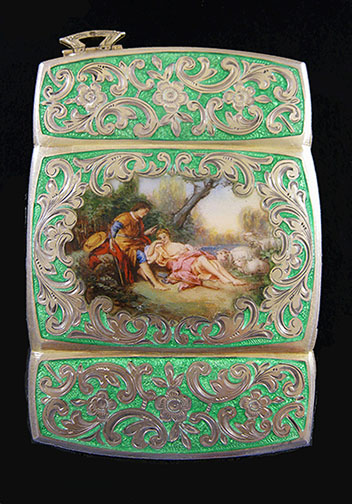
And the same on an unusual vanity (powder, rouge, lipstick) featuring cloisonné front and back. It is marked with the Hoopoo 1W mark (.935 silver, Austria after 1922) with a vertical orientation from the front but horizontal inside. Could this have been a custom made compact to fit someone's particular pocket or purse?
Boucher was extremely
popular with compact artists and they used many of his works like…
Bird Cage (ca. 1743) marked 800 …
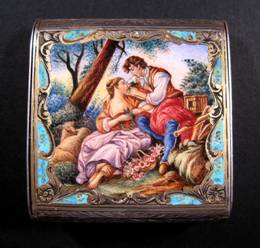
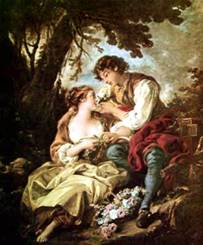
Bird Cage (ca. 1740) marked 800, illegible in lozenge, 6 in powder well.
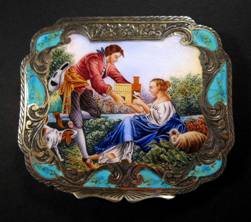
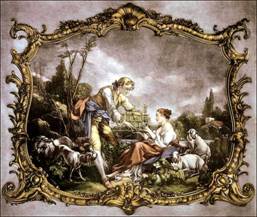
Just a note about bird imagery – it is very common on these compacts and in the paintings of the 18th century and this is no accident. In German, the slang for a man’s private parts was the same word as bird, so this symbolism carried a lot of meaning to those who saw these pictures. And who knows? Maybe that is the origin of our slang phrase of “flipping the bird”! A birdcage (where you keep your bird) was often seen as representing a young lady’s virtue – a closed door meant she was virtuous and an open door – well, maybe not so virtuous! This will bring a whole new dimension to your appreciation of these compacts, I’m sure! To continue with the works of Boucher used on compacts…
Shepherd Piping to
a Shepherdess (ca. 1750) marked 800, illegible in lozenge …
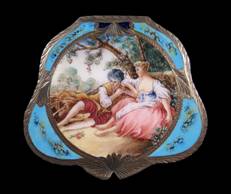
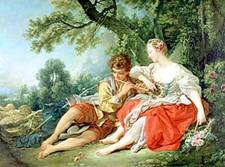
The Nest (1743) marked 800, Coppini, 278 in lozenge, 5 in powder well
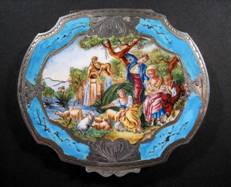
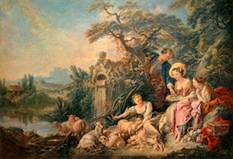
Rinaldo
and Armida (a scene from Torquato
Tassos’s opera, Gerusalemme
liberata of 1711) (1734) marked 800, 117 in lozenge, 5 in powder well...
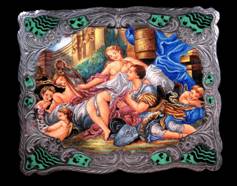
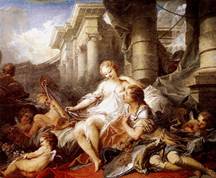
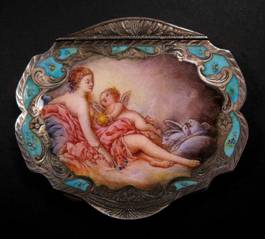
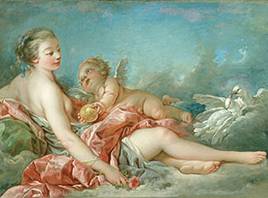
Venus and Cupid (1754) marked 800, 190O in lozenge. This is an allegory
of the Judgment of Paris, the event that started the Trojan War. It is
recounted that Zeus
held a banquet in celebration of the marriage of Peleus and Thetis (parents of Achilles).
However, Eris, goddess of discord, was uninvited.
Angered by this snub, Eris arrived at the celebration, where she threw a golden apple
(the Apple of Discord) into the proceedings, upon which was the inscription καλλίστῃ ("for the fairest
one"). Three goddesses claimed the apple: Hera, Athena
and Aphrodite
(Venus). They asked Zeus to judge which of them was fairest, and eventually
Zeus, reluctant to favor any claim himself, declared that Paris, a Prince of Troy, would judge their
cases. All three of the candidates appeared to
La Musette (ca. 1740) marked 800, 210 in lozenge, 17 in powder well …
Charms of the
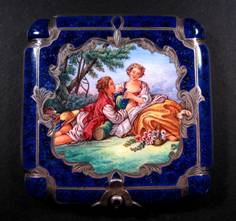
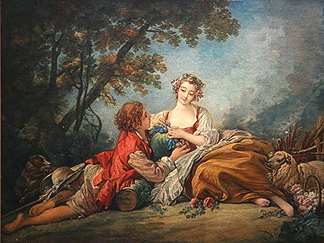
Country Life (1740) marked 800, Coppini, 278 in lozenge …
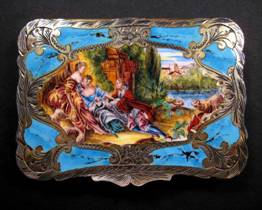
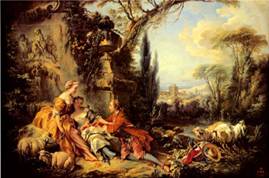
Are They Thinking
About the Grape? (1747) This
compact is especially lovely because of the sides decorated with swags and wreaths done in champlevé and blue
enamel…
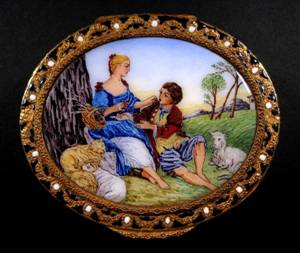
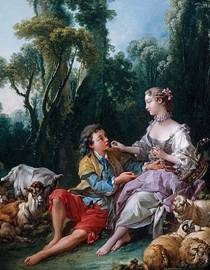
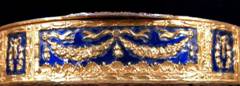
Interrupted Sleep
(1750) on an example by Stratton…
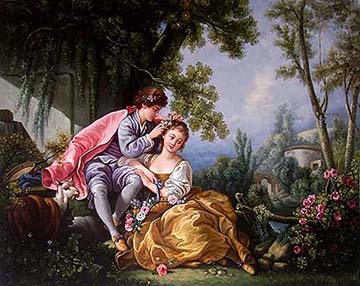
The Four Seasons:
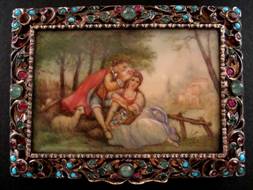
Spring (1755) marked 800, on this jeweled Italian beauty…
 .....
.....
and another version marked 800 and 210 in lozenge...
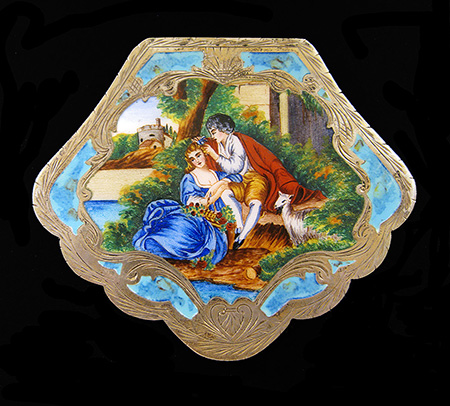
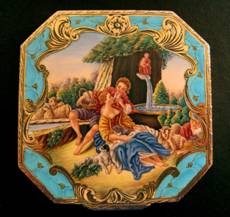
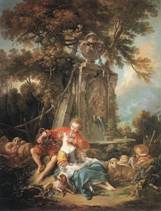
An Autumn Pastoral (1749) marked 800, marked 2?? in lozenge, 1 in powder well …
 ........
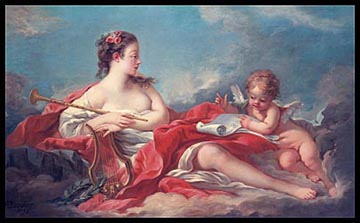
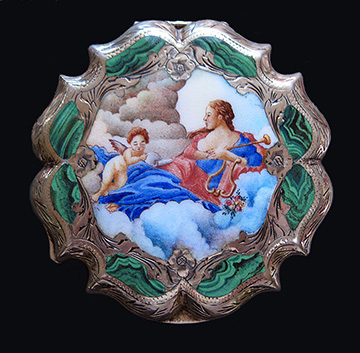
The Muse Clio (ca. 1758) marked 800, 117 in lozenge, 4 in powder well. Clio or Kleio is the Muse of history. Like all the Muses, she is a daughter of Zeus and Mnemosyne. She is often represented with a parchment scroll or a set of tablets and a trumpet and is also known as the Proclaimer. The name is from the Greek root meaning "recount" or "make famous".
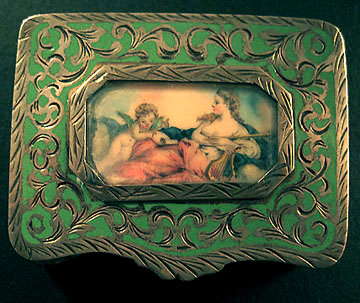 ........
Another of the same marked 800 with swan, illegible in lozenge
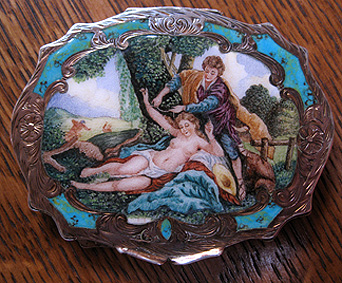
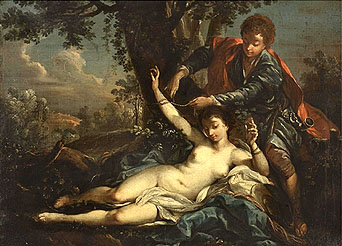
Aminta Rescues Sylvia (after François Boucher) (ca 1750) marked 800, 220 w/swan in lozenge. Torquato Tasso's pastoral drama or love-idyll, Aminta, is highly esteemed in Italy. It belongs to the period of his happiness at the court of Ferrara, then the most brilliant in Italy . It was intended especially for the entertainment of the great ladies who had graciously received him and befriended him. Aminta was first performed in 1573 before the duke Alphonso and his court, to the intense delight of that gay and cultured assembly. This skillful blending of poetry, music and dramatic art exactly suited the spirit of the age in which it appeared. It was at that very time that music was becoming the main art of Italy . Thenceforth the influence of this enchanting composition was felt in opera and cantata for more than two centuries throughout Europe .
The plot of this lyrical drama is simple. Aminta, a shepherd hero, has spent his boyhood in constant companionship with the shepherdess Sylvia. But a sad change has come over their relation since his boyish friendship has ripened into ardent love. The crisis came when she was deluded into attempting to charm away the pain of a pretended bee's sting on his lip by kissing him. Thenceforth she has repelled his increasing and persistent attentions and declares herself a votary of Diana. She becomes a huntress and finds pleasure only in the chase of wild beasts. Sylvia even declares that she hates her former comrade, and Aminta, in despair, threatens that his misery must end in death, which alone can appease her. But Sylvia before starting on a hunting expedition with her friend, goes to bathe in a favorite pool. There the girls are surprised by a fierce satyr, who seizes and carries off Sylvia while Daphne escapes to give an alarm. Aminta hastens to the woods and finds Sylvia tightly bound to a tree, fastened by her hair and girdle and twigs. Though hesitating at first to approach, he partially releases her, when she, vexed at being discovered in such distress, bids him begone without thanking him. The dismayed Aminta speedily retires, and Sylvia, unfastening the twigs which still detained her, flees in the opposite direction. But in the next act a messenger brings word that Aminta, rushing to the brow of a precipice, has thrown himself headlong. Sylvia, overcome with horror at hearing of his death, begs to be lead to the place, that she may atone for her fault. The lover's body is found at the foot of a cliff, and a shepherd who was standing near reports that the fall was broken by a tree and bushes. Sylvia flings herself upon the lifeless form and laments her past cruelty and hardness of heart. Aminta revives, and, opening his eyes, finds himself clasped in her arms. It soon appears that, except for some scratches and bruises, he has escaped serious injury. "Happy is he who has given so great proof of his love and now tastes relish."
 ...............
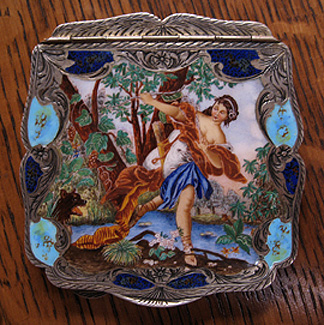
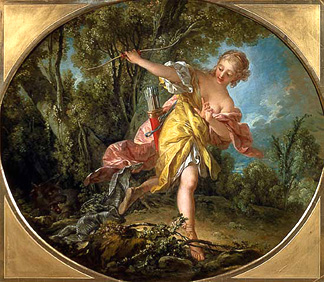
Rhea Silvia Fleeing from the Wolf (also written as Rea Silvia )(1756) marked 800, 9 in powder well. Rhea Silvia, also known as Ilia , was the mythical mother of the twins Romulus and Remus, who founded the city of Rome . Her story is told in the first book of Ad Urbe Condita of Livy and in fragments from Ennius, Annales and Fabius Pictor. According to Livy's account of the legend, Rhea Silvia was the daughter of Numitor, king of Alba Longa and descended from Aeneas. Numitor's younger brother Amulius seized the throne and killed Numitor's son, then forced Rhea Silvia to become a Vestal Virgin, a priestess of the goddess Vesta. As Vestal Virgins were sworn to celibacy for a period of thirty years, this would ensure the line of Numitor had no heirs. However, Rhea Silvia conceived and gave birth to the twins Romulus and Remus, claiming that the god Mars had discovered her in the forest and seduced her. When Amulius learned of the birth he imprisoned Rhea Silvia and ordered a servant to kill the twins. But the servant showed mercy and set them adrift on the river Tiber which, overflowing, left the infants in a pool by the bank. There a she-wolf ( Lupa ), who had just lost her own cubs suckled them. Subsequently Faustulus rescued the boys, to be raised by his wife Larentia. Romulus and Remus went on to found Rome , overthrow Amulius, and reinstate Numitor as King of Alba Longa. The name Rhea Silvia suggests a minor deity a demi-goddess of forests, Silva means woods or forest, and Rea may be related to res and regnum ; Rea may also be related to Greek rheô , "flow," and thus relate to her association with the spirit of the river Tiber.
 .............
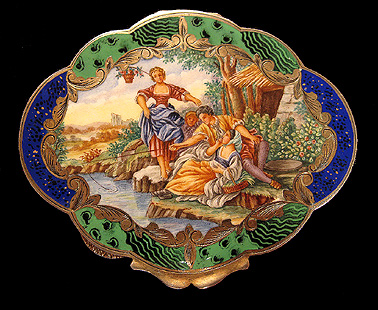
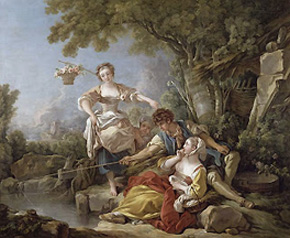
Pleasures of Fishing (after François Boucher) (ca. 1750) marked 800, 3 in powder well and illegible in lozenge
 .................
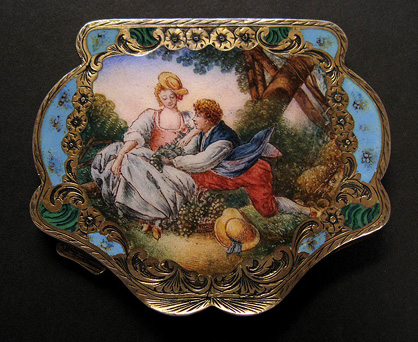
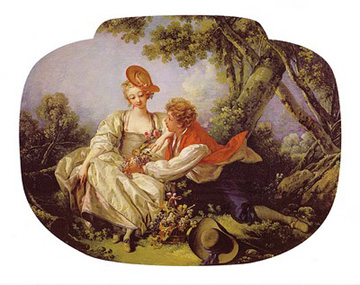
The Four Seasons: Autumn (1755) marked 800 and "Fallaci Firenze"
 ..................
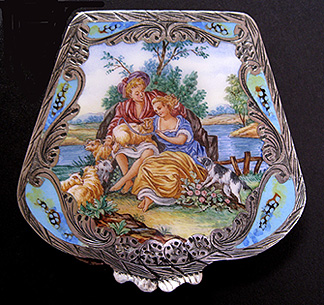
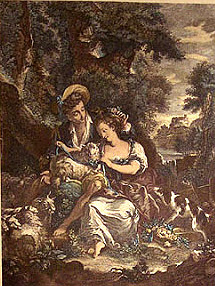
Le Mouton Favorie (late 18th century) marked 800, illegible in lozenge, 7 in powderwell. Known from an 18th century engraving by René Gaillard.
 ................
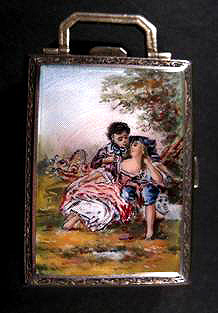
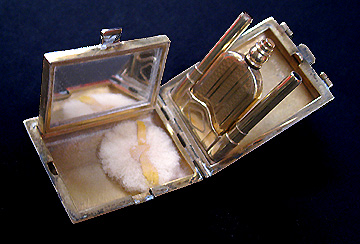
Lovers' Tryst (late 18th century) marked 925, PHV with continental silver marks in well behind perfume bottle. The real beauty of this one is its size - It measures 1.5" x 1.25" and within this tiny space there is a compact with puff, mirror, perfume bottle, mascara and lipstick! Also featuring Lovers' Tryst is this beauty from Austria below.
 ....
.... ..
..
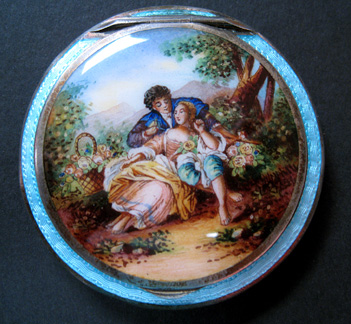
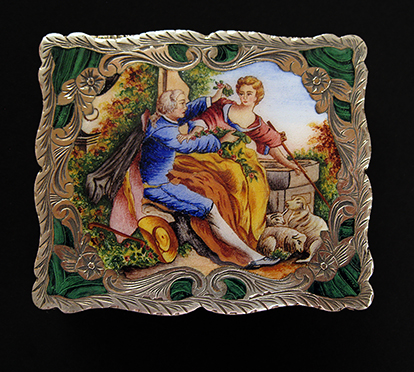
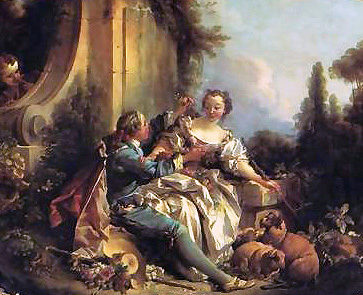
The Amorous Shepherd or Shepherd and Shepherdess by a Fountain (late 18th century) marked 800 and 117 in lozenge...
 ...
...
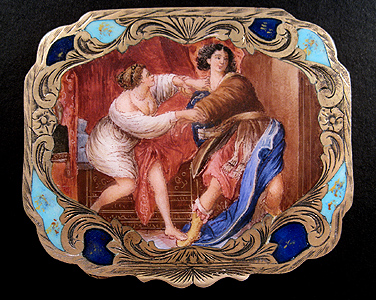
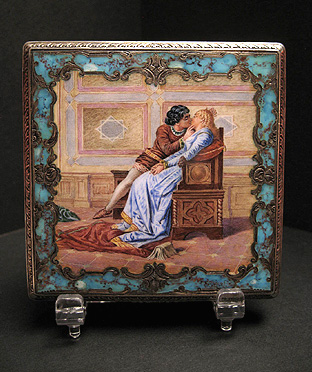
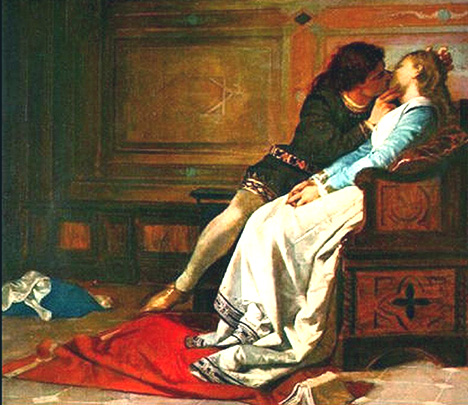
Paolo e Francesca (1870) by Amos Cassioli, Pre-Raphaelite (1832–1891) marked 800, 46 w/fasces in lozenge. Cassioli was a nineteenth-century Italian painter, born in Asciano in 1832. After studying at the Sienese Accademia di belle arti he studied in Rome . At the end of 1860 he established himself in Florence which, although he maintained his links with Siena , became his permanent home. Regarded as an excellent portraitist, Cassioli is also noted for his large-scale history paintings which include the Battaglia di Legnano (1860-1870, Florence , Galleria di arte moderna , Palazzo Pitti) and Il giuramento di Pontida (1884, Siena , Palazzo Pubblico ). Between 1884 and 1886 he executed frescoes in the Sala del Risorgimento of the Palazzo Pubblico in Siena depicting the battles of San Martino and Palestro. He was known also for paintings on classical subjects; many of these, following a 1991 bequest, are conserved in the Museo Cassioli of his native town Asciano. Amos Cassioli died in Florence in 1891.
In Dante's Inferno, Canto V,
Francesca da Rimini and Paolo Malatesta are punished together in hell for their adultery: Francesca was married to Paolo's brother, Gianciotto ("Crippled John"). Francesca's shade tells Dante that her husband is destined for punishment in Caina--the infernal realm of familial betrayal named after Cain, who killed his brother Abel (Genesis 4:8)--for murdering her and Paolo. Francesca was the aunt of Guido Novello da Polenta, Dante's host in Ravenna during the last years of the poet's life (1318-21). She was married (c. 1275) for political reasons to Gianciotto of the powerful Malatesta family, rulers of Rimini . Dante may have actually met Paolo in Florence (where Paolo was capitano del popolo --a political role assigned to citizens of other cities--in 1282), not long before he and Francesca were killed by Gianciotto.
Although no version of Francesca's story is known to exist before Dante, Giovanni Boccaccio--a generation or two after Dante--provides a "historical" account of the events. Even if there is more fiction than fact in Boccaccio's account, it certainly helps explain Dante-character's emotional response to Francesca's story by presenting her in a sympathetic light. Francesca, according to Boccaccio, was blatantly tricked into marrying Gianciotto, who was disfigured and uncouth, when the handsome and elegant Paolo was sent in his brother's place to settle the nuptial contract. Angered at finding herself wed the following day to Gianciotto, Francesca made no attempt to restrain her affections for Paolo and the two in fact soon became lovers. Informed of this liaison, Gianciotto one day caught them together in Francesca's bedroom (unaware that Paolo got stuck in his attempt to escape down a ladder, she let Gianciotto in the room); when Gianciotto lunged at Paolo with a sword, Francesca stepped between the two men and was killed instead, much to the dismay of her husband, who then promptly finished off Paolo as well. Francesca and Paolo, Boccaccio concludes, were buried in a single tomb.
 ............
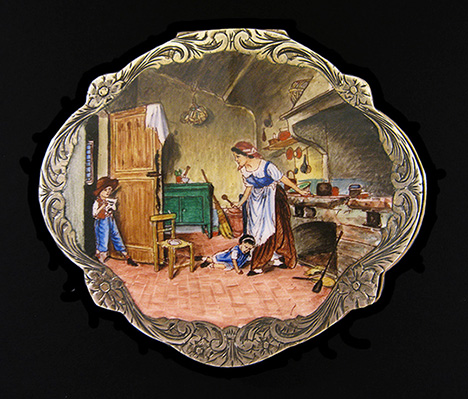
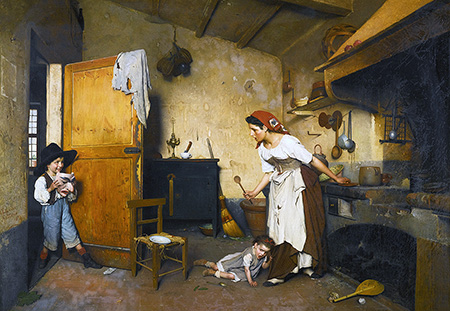
La Maschera by Gaetano Chierci (Italian, 1874) marked 800, 117 in lozenge and 4 in powderwell..
 ................
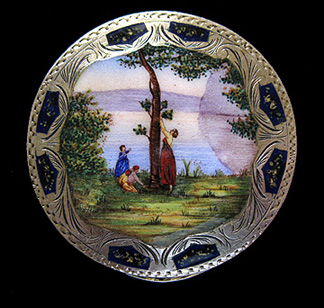 ...........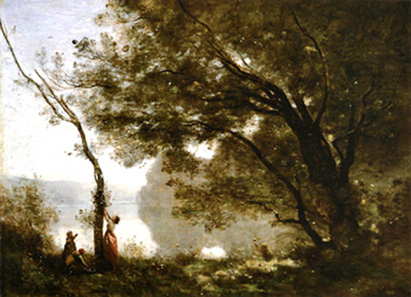
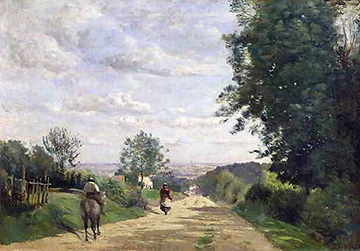
Also by Corot The Road to Sevres (11858-59) marked 800, 220 in lozenge with a swan...
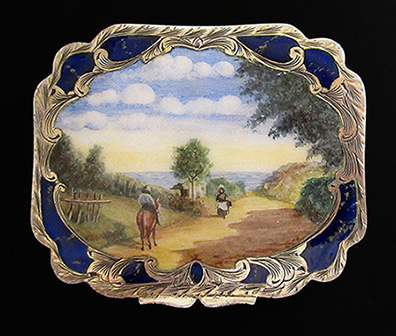 ......
Another artist, Pierre Auguste
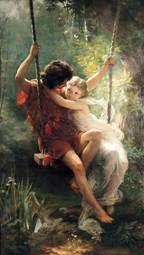
Cot, French Academic, painted Springtime
(1873)and it became an iconic image of the day, appearing on everything from soap boxes
to flour sacks. Here it is on a fine tango by F&B…
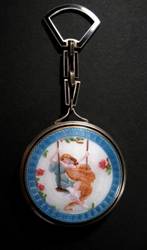
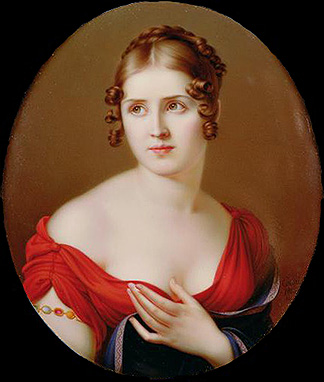
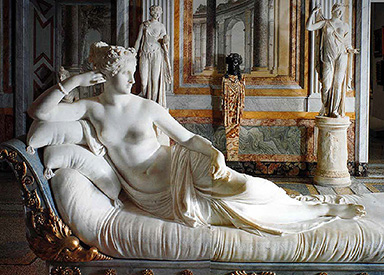
The Beautiful Greek, Marie-Pauline Bonaparte, Princess Borghese by Salomon Guillaume Counis (1810) Marie-Pauline, also known as Paulette, was the sister of Napoleon I and a great beauty of her era. Her epithet, "The Beautiful Greek", is possibly due to her posing for the famous nude Venus Victrix by Antonio Canova (image below).
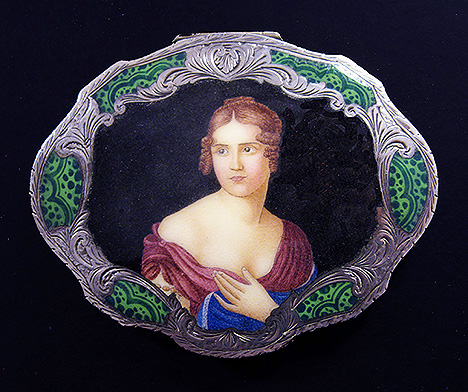 ..........
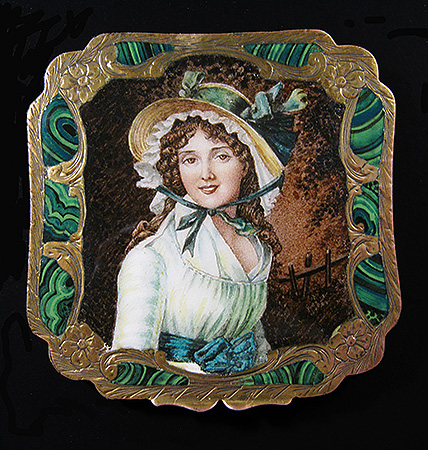
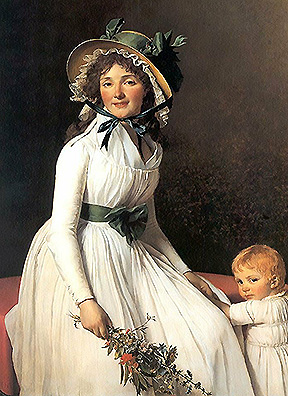
Madame Seriziat by Jacques Louis David (1795) marked 800 with swan and 203? in lozenge. In 1794, Jacques-Louis David was in prison in France. He had been an enthusiastic revolutionary, follower of Robespierre, a member of the feared Committee of Public Safety, and had signed the death warrant of Louis XVI. Now, with his political allies either dead or out of power, David found himself facing a possible death sentence. His brother-in-law, Charles Seriziat, was well-connected and intervened on David’s behalf, securing his release. The grateful painter painted this portrait of his sister-in-law Emilie, Madame Seriziat.
 ............................
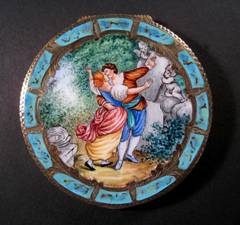
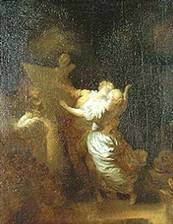
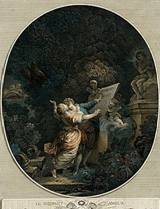
Le serment d’amour (Love Vow) by Jean-Honoré Fragonard, French Baroque (ca.
1765) is actually better
known from the engraved copy by Jean Mathieu (ca. 1800) (below) marked 800, 291? in lozenge, 15 in powder well.
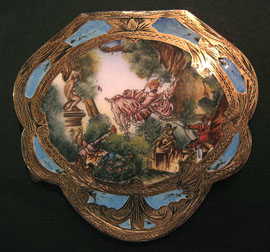
The Swing (1767) marked 800, 5 and 7 in powder well...
 ...........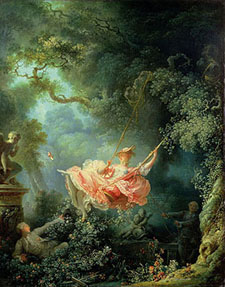
Excerpt from Hugh Honour and John Fleming, The Visual Arts: A History , 6th edition, p. 628: The origin of Fragonard's The Swing is by chance known. The writer Charles Collé recorded having met the painter Gabriel-Fran çois Doyen on 2 October 1767: 'Would you believe it!' A gentleman of the court had sent for him shortly after a religious painting of his had been exhibited in Paris and when Doyen presented himself he found him at his 'pleasure house' with his mistress. 'He started by flattering me with courtesies', Doyen related, 'and finished by avowing that he was dying with a desire to have me make a picture, the idea of which he was going to outline. "I should like", Madame (pointing to his mistress) on a swing that a bishop would set going. You will place me in such a way that I would be able to see the legs of the lovely girl, and better still, if you want enliven your picture a little more..." I confess, M. Doyen said to me, that this proposition, which I wouldn't have expected, considering the character of the picture that led to it, perplexed me and left me speechless for a moment. I collected myself, however, enough to say to him almost at once: "Ah Monsieur, it is necessary to add to the essential idea of your picture by making Madame's shoes fly into the air and having some cupids catch them." Doyen did not accept the commission, however, and passed it on to Fragonard. The identity of the patron is unknown, though he was at one time thought to have been the Baron de Saint-Julien, the Receiver General of the French Clergy, which would have explained the request to include a bishop pushing a the swing. This idea as well as that of having himself and his mistress portrayed was evidently dropped by the patron, whoever he may have been. The picture was depersonalized and, due to Fragonard's extremely sensuous imagination, became a universal image of joyous, carefree sexuality.
The theme is that of love and the rising tide of passion, as intimated by the sculptural group in the lower centre of the picture. (Dolphins driven by cupids drawing the water-chariot of Venus symbolize the impatient surge of love). Beneath the girl on the swing, lying in a great bush, a tangle of flowers and foliage, is the young lover, gasping with anticipation. The bush is, evidently, a private place as it is enclosed by little fences. But the youth has found his way to it. Thrilling to the sight now offered him, the youth reaches out with hat in hand. (A hat in eighteenth-century erotic imagery covered not only the head but also another part of the male body when inadvertently exposed.) The feminine counterpart to the hat was the shoe and in The Swing the girl's show flies off her pretty foot to be lost in the undergrowth. This idea had been /p. 629: suggested originally by Doyen, as he recounted to Collé, and in French paintings of the period a naked foot and lost shoe often accompany the more familiar broken pitcher as a symbol of lost virginity.
However, all these erotic symbols would lie inert on the canvas had not Fragonard charged the whole painting with the amorous ebullience and joy of an impetuous surrender to love. In a shimmer of leaves and rose petals, lit up by a sparkling beam of sunshine, the girl, in a frothy dress of cream and juicy pink, rides the swing with happy, thoughtless abandon. Her legs parted, her skirts open; the youth in the rose-bush, hat off, arm erect, lunges towards her. Suddenly, as she reaches the peak of her ride, her shoe flies off.
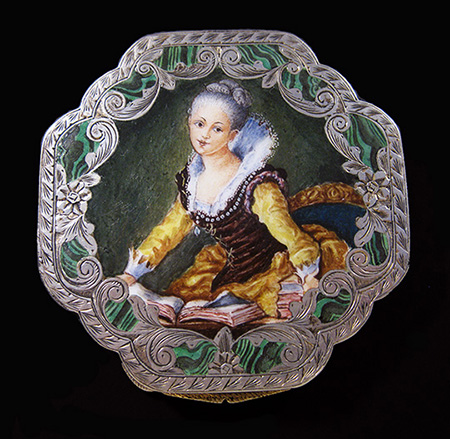
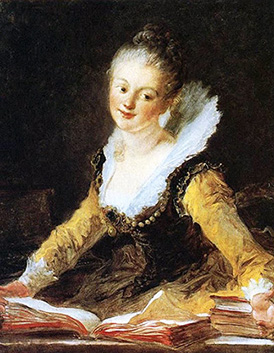
Also by Fragonard, Portrait of a Young Girl (Study or Song) (1769), 800 in oval, 25, 15 or 75? with fasces in elongated hexagon...
. ..............
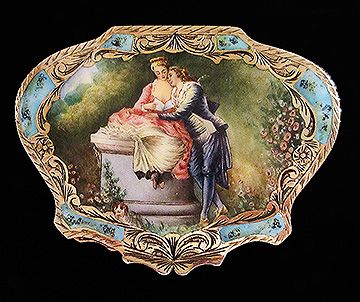
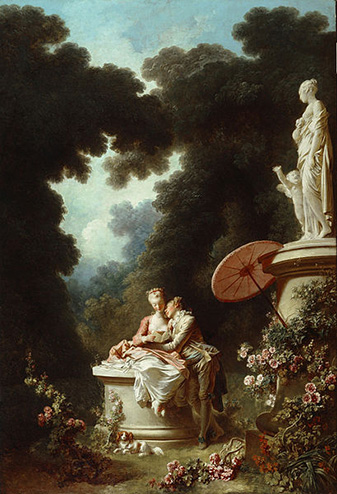
Also by Fragonard The Progress of Love or Love Letters (1771-1772) marked 800 and 180? in lozenge
 ..........
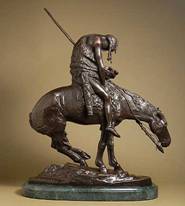
End of the Trail (1915) sculpture in plaster
by James Earl Fraser on a silver
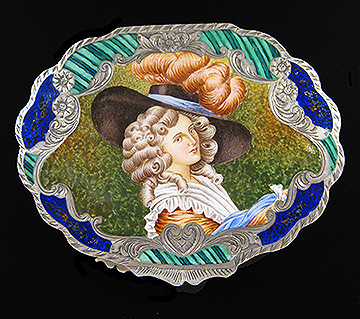
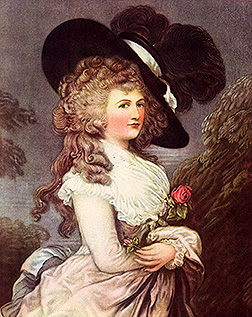
Lady Georgina Cavendish, Duchess of Devonshire by Sir Thomas Gainsborough marked only 800...
 ..............
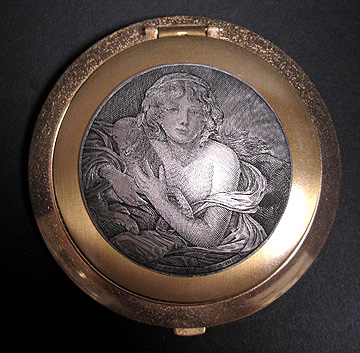
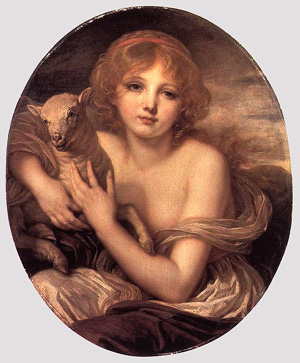
Innocence by Jean Baptiste Greuze Rococo (ca. 1790) in grisaille to resemble engraving
 .............
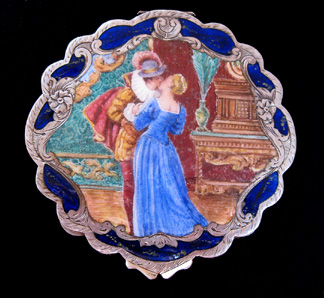
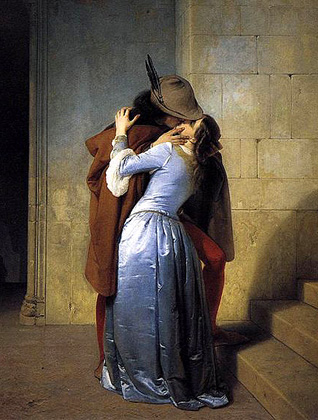
This scene is probably adapted from The Kiss by Francesco Hayez Italian (1859), marked 800 w/swan and 220 in lozenge
 ......
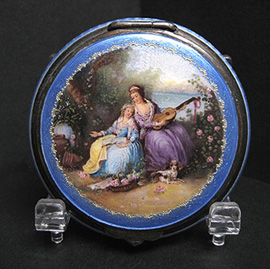
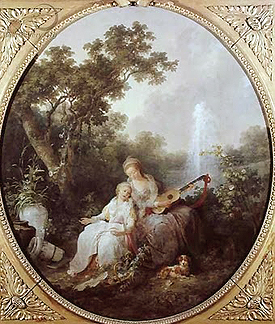
Music by Jean-Baptiste Hilaire French Academic (1781)...
 ...........
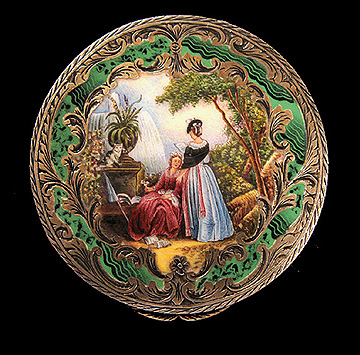
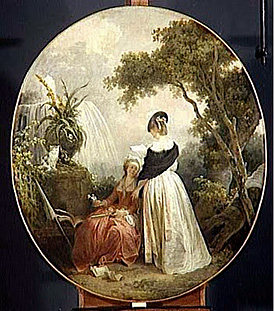
La Lecture, also by Hilaire (1781) marked 800 and 117 in lozenge
 ...........
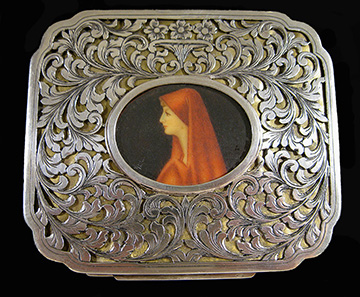
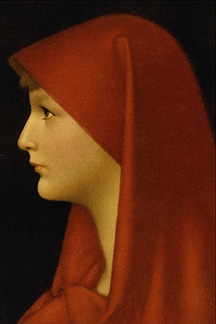
Fabiola by Jean Jacques Henner (1885) French Academic marked 800 and 28_? in lozenge. Henner was noted for his use of sfumato and chiaroscuro in painting nudes, religious subjects, and portraits. Fabiola was a Roman matron of noble birth who lived in the 4th century AD. Her first marriage to an abusive and unfaithful husband ended in a divorce, her second in widowhood. After this she embarked on a life of self-denial and good deeds. She is said to have built the first hospitals in Rome, and is therefore the patron saint of nurses. Because of her unhappy marital experience, she is also prayed to by divorcées, by women in unhappy marriages, and by battered wives.
 ...............
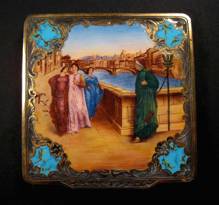
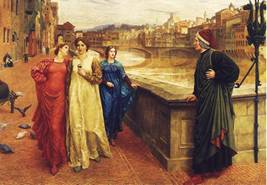
Dante and Beatrice by Henry Holiday, British Pre-Raphaelite
(1883) marked 800, lozenge illegible, 8 in powder well. Dante fell madly in love with Beatrice from afar in the style of
courtly love of the day (13th -14th century
 ............
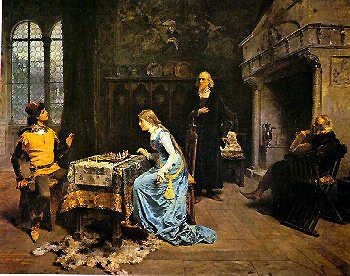
La Partita a Scacchi by Geralamo Induno (1881) marked 800, illegible in lozenge. Induno was an Italian painter of the mid-19th century and a patriot who fought in defense of his country against Austria and France and with Garibaldi for the independence of Italy...
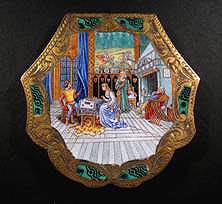 ............................
The Source by Jean-Auguste-Dominique Ingres, French Academic (1856) marked 800 …
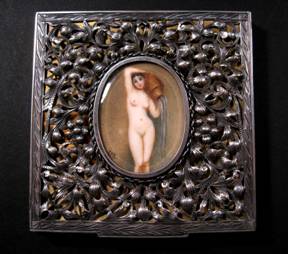
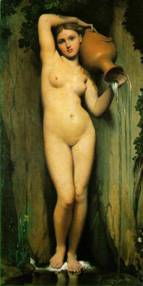
Cupid Bound by the Graces (Beauty, Charm, Joy) by Angelica
Kauffman, Swiss Neo-Classicism (1770) marked 800, 3 in powder well. Unlike many female artists of the period,
Kauffman was very popular and wealthy in her time. She painted allegorical,
mythological and historical subjects, as well as subjects from literature and
portraits. They are mostly treated in the sentimental fashion of the 18th century.
In the paintings of her early Roman period, drawing prevails over coloring,
which shows her interest in the aesthetic ideas of neo-classicism. The works of
Kauffman were widely known in
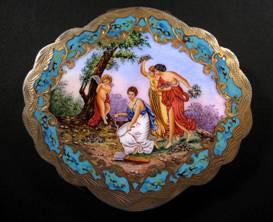
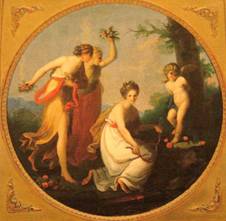
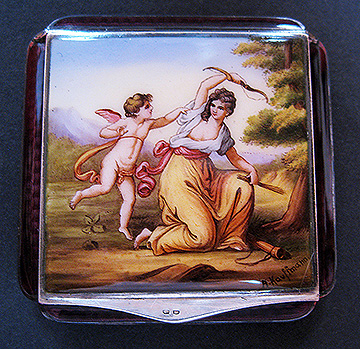
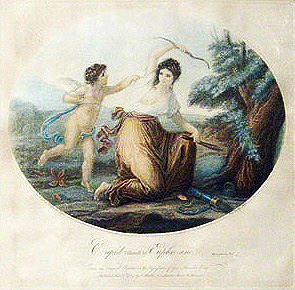
Also by Kauffman, Cupid Disarmed by Euphrosyne (late 18th century) on a fine Austrian sterling compact. According to Greek myth, Euphrosyne was one of the Charities, daughters of Zeus and the Oceanid Eurynome. The Greek poet Pindar states that these goddesses were created to fill the world with pleasant moments and good will. They usually attended the goddess of beauty Aphrodite and her companion Eros and loved dancing around in a circle to Apollo’s divine music, together with the Nymphs and the Muses. Euphrosyne is also the Goddess of Joy or Mirth, and the incarnation of grace and beauty. The other two Charites are Thalia (Good Cheer) and Aglaea (Beauty or Splendor).
 .............................
, 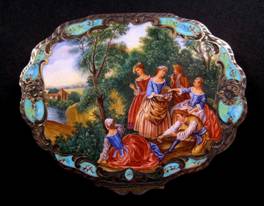
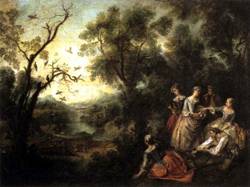
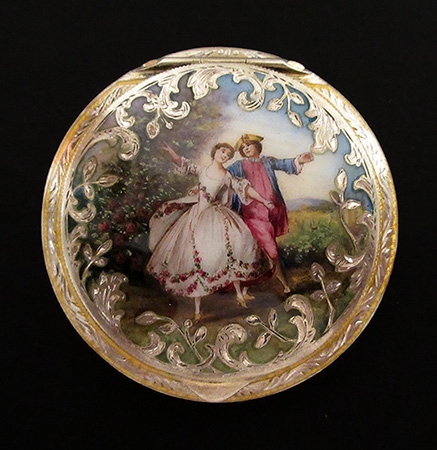
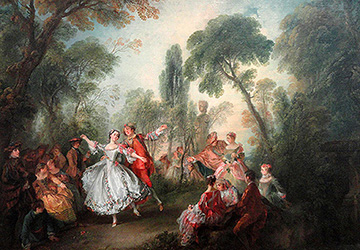
Mademoiselle Camargo
Dancing (1730) marked 800, 240 in lozenge … Marie-Anne
de Camargo Cupis, known as La
Camargo was a famous Belgian dancer of the 18th century…
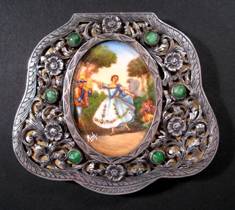
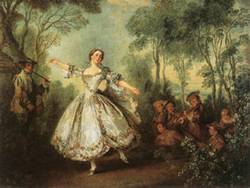
Another version on an Austrian compact...
 ......
Innocence (1743) marked 800 …Note that the lady is holding a tiny bird tethered by a string. In some compact versions of this picture, if the copyist does not have room for the tethered bird, he sometimes substitutes a bouquet of flowers.
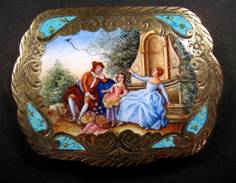
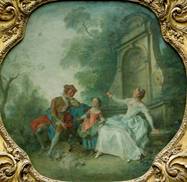
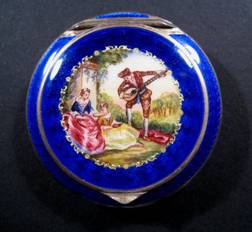
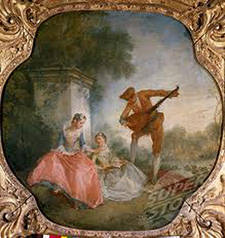
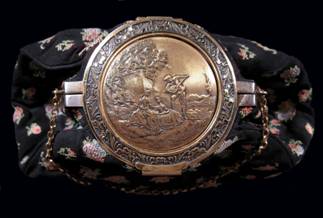
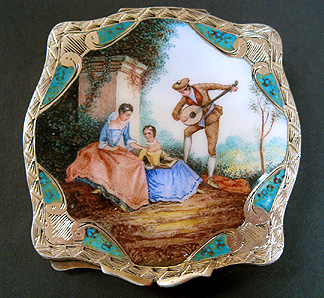
The Music Lesson (1743) on a fine Austrian compact, on an Evans Mayfair vanity bag and on a fine Italian compact marked 800 w/swan and 220 in lozenge
 ....
....
Birdcage (ca. 1740) marked 800, illegible in lozenge and "Fallaci Firenze"...
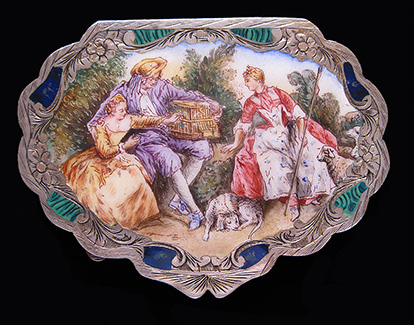
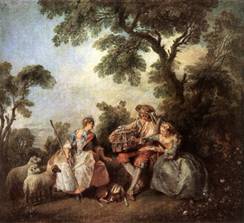
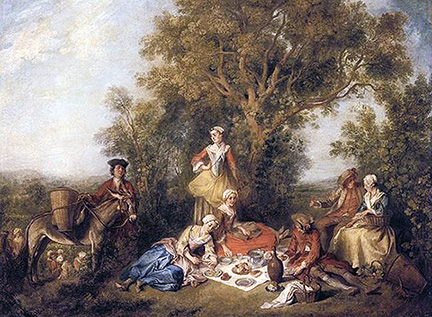
Also by Lancret, Automne (1738), marked only 800...
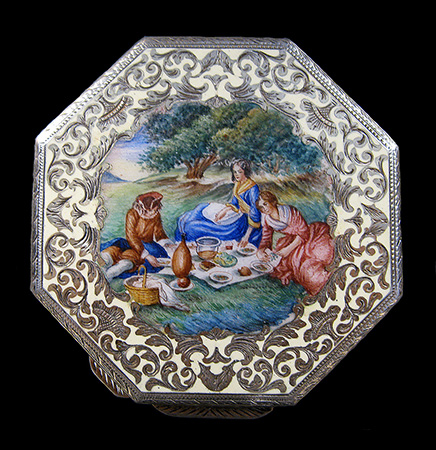 ..........
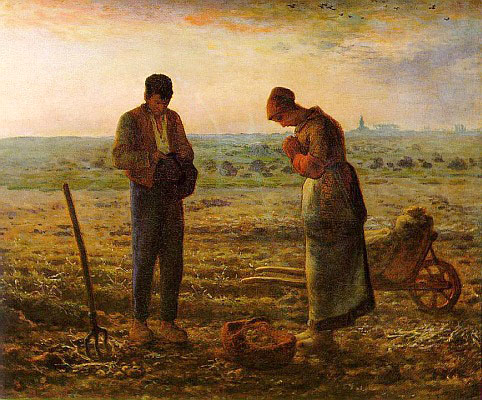
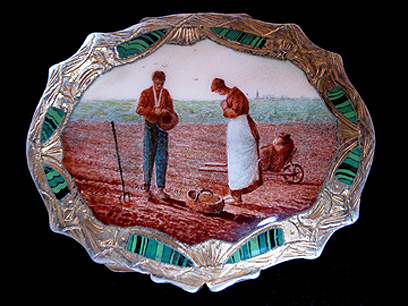 ...
...
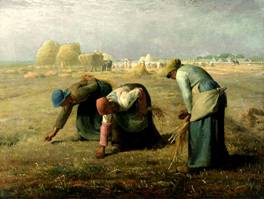
The Gleaners by Jean François Millet, French Realism –
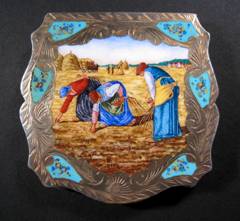
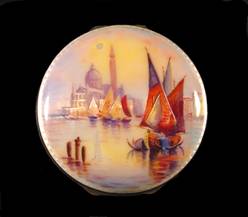
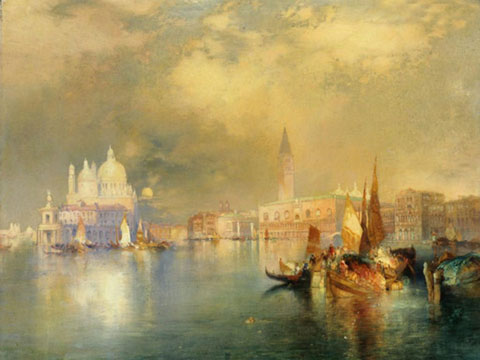
Moonlight in Venice by Thomas Moran, American Romantic (1898) on a fine British compact. Moran was an American who painted this view of Venice many times at different seasons and times of day. This version was taken by the compact painter and compressed to fit this very small compact. The bell tower (campanile) in St. Mark's Square to the right has been moved to the left to appear much closer to Santa Maria della Salute than it actually is. As a result, the moon has been moved to a higher spot on the compact than it is in Moran's painting.
 ...............................
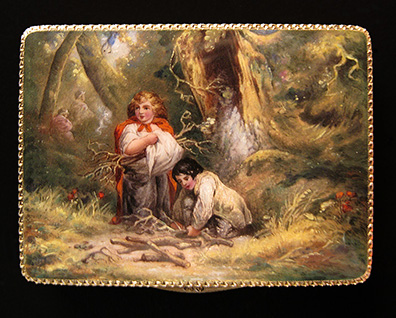
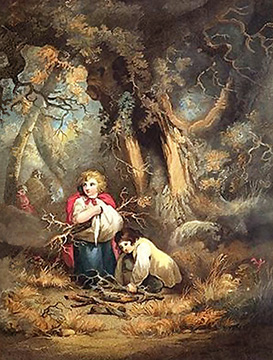
Gathering Wood by George Morland (ca 1800) Morland was was an English painter of animals and rustic scenes.
 ...................
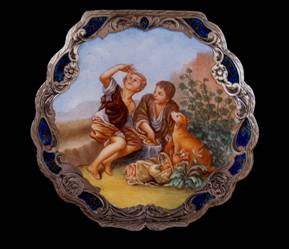
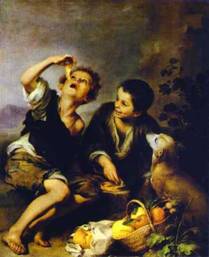
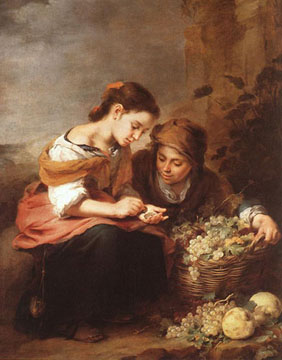
Two Boys Eating a Tart by Barolomé Esteban Murillo, Spanish Baroque (1660) marked 800, 190 in lozenge. Bartolomé Esteban Murillo was a Spanish painter, one of the most important figures in Baroque
painting in
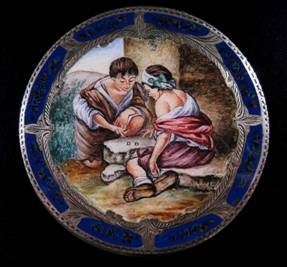
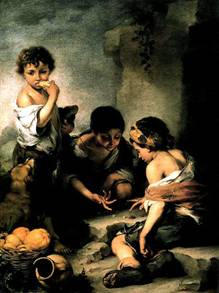
Also by Murillo, Boys Playing Dice (ca. 1675) marked 800, Bellini Florence, 291? in lozenge, 4 in powder well
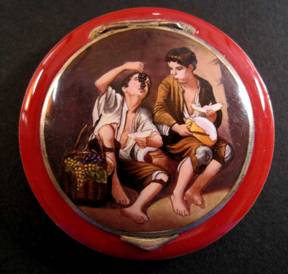
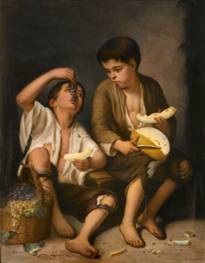
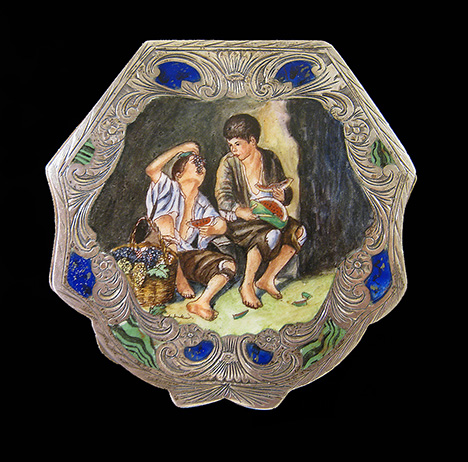
Also by Murillo, Grape and Melon Eaters (1645)…
And another Italian 800 version marked 800 and 117 in lozenge
 ........
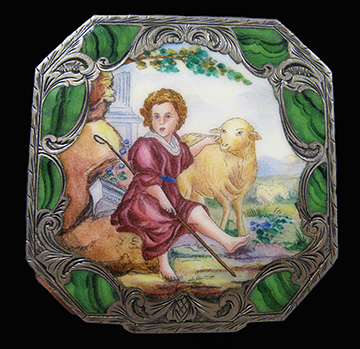
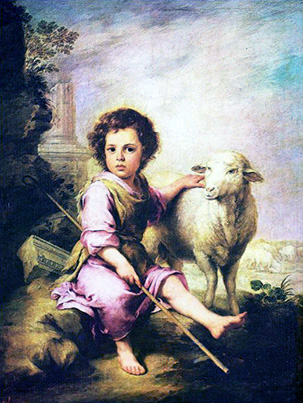
Also by Murillo, Shepherd Boy with Lamb, (ca 1665) marked 800 and 21? in lozenge (last number illegible)
 ........
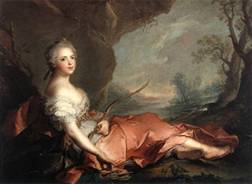
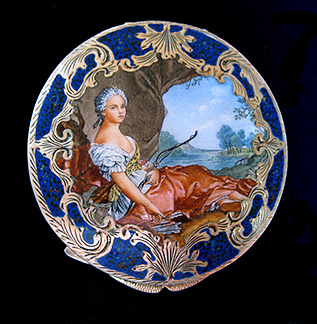
Madame Adelaide by Jean-Marc Nattier, French Rococo portraitist (ca. 1740). Marie Adélaïde de France (1732-1800) was a French princess. She was the fourth daughter and sixth child of King Louis XV of France and his Queen Consort, Maria Leszczynska. As the daughter of the king, she was a Fille de France...
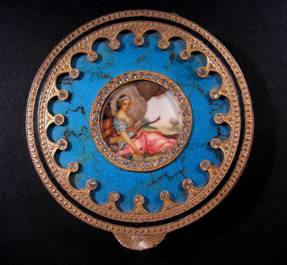
Also by Nattier, Henriette
de Bourbon (ca. 1750). Louise Henriette de
Bourbon-Conti, duchesse d'Orléans was a French
princess, who by marriage was first the duchesse de
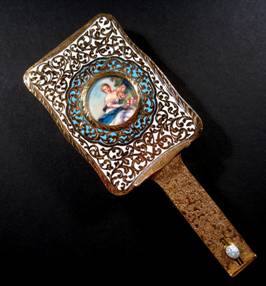
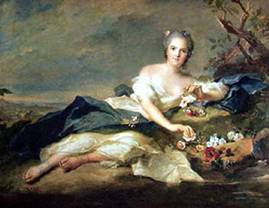
Another, marked 800 and 117 in lozenge
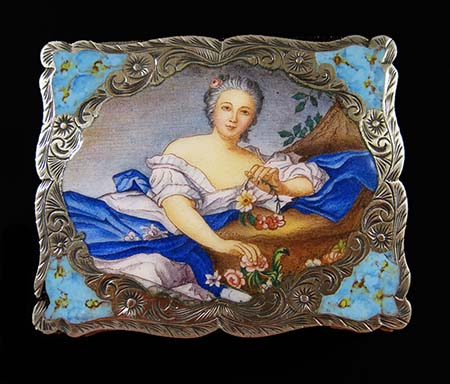
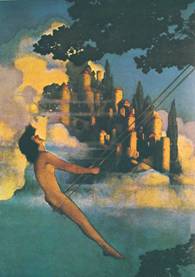
Dinky Bird by Maxfield Parrish, American Illustrator (an illustration from Poems of Childhood by Eugene Field) (1904) on a vanity by D.F. Briggs & Co…
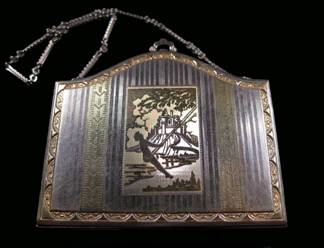
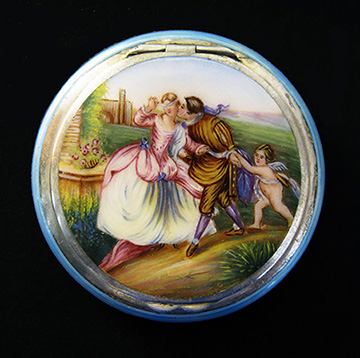
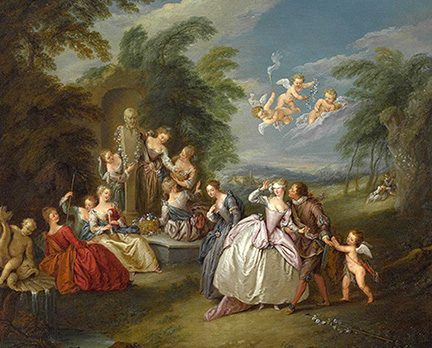
The Blindman's Buff by Jean Baptist Pater (1720) French Rococo, marked "Germany Sterling"
 ..........
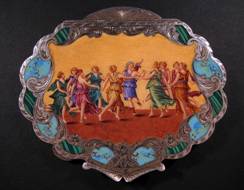
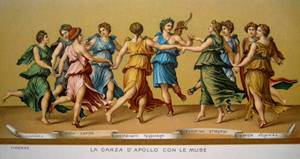
Dance of Apollo and the Muses by Baldassare Peruzzi, Italian Renaissance (ca. 1500) marked 800 …
The Head of
Cleopatra (or Simoneta Vespucci) by Piero di Cosimo (Pietro di Lorenzo), Italian Renaissance (ca. 1489) marked 800, 223or 220 in lozenge, 3 in powder well. Simoneta was the mistress of Lorenzo di
Medici and the wife of a cousin of Amerigo Vespucci
who gave his name to
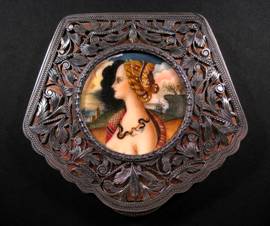
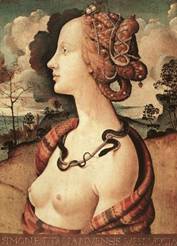
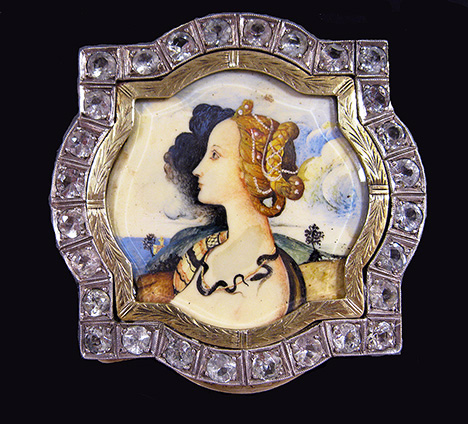
Another example with a crystal border marked 800 and illegible in lozenge...
Portrait of a Lady by Antonio del Pollaiuolo, Italian Renaissance (ca. 1457) on a vanity by Mondaine…
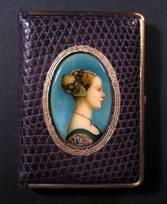
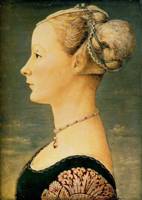
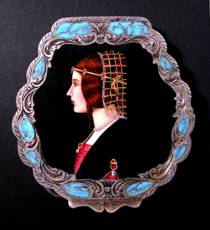
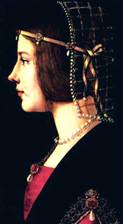
A portrait of a Lady (Beatrice d’Este) by Ambrogio de Pretis, Italian Renaissance (1495-1500) marked 800. De Pretis was a student of Leonardo da Vinci and his works are often attributed to his teacher.
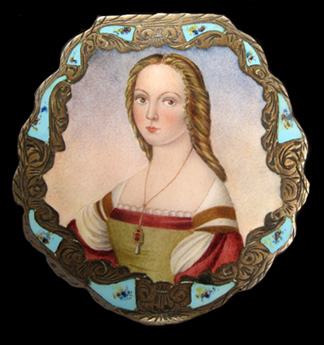
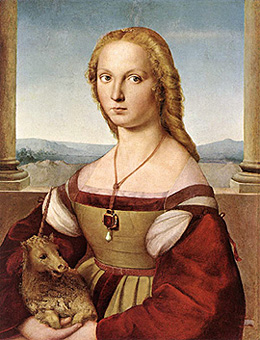
Portrait of a Lady with Unicorn by Raphael Sanzio da Urbino, Italian Renaissance (1505-1506) marked 800, 3 in powder well and 203 in lozenge
 ...............
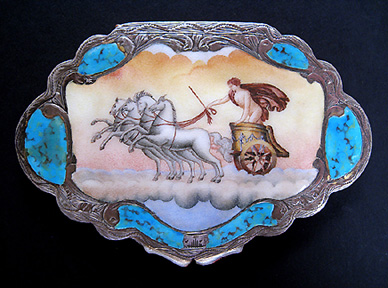
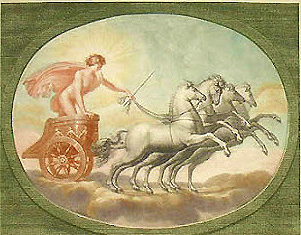
Apollo, from an engraving based on a lost fresco by Raphael, one of a sseries of four depicting Apollo, Mars, Mercury and Venus in chariots. The drawings and engravings were made c. 1780-1820 by Franco Staccoli, Agostino Tofanelli and Stefano Tofanelli (draftsmen) and Pietro Bonato, and Giuseppi Bortignoni (engravers). Marked 800, 220 in lozenge w/swan
 ........
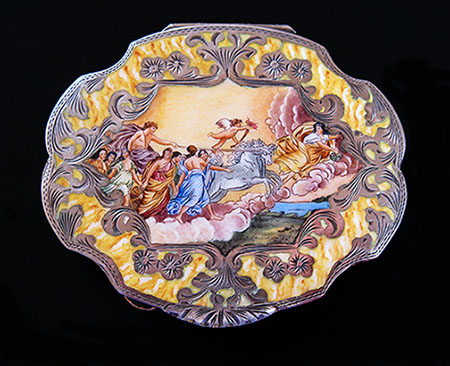
Phoebus and the Hours Preceded by
Aurora by Guido Reni, Italian Baroque (a fresco in
the
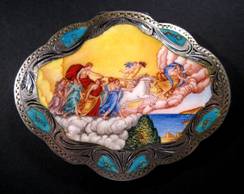
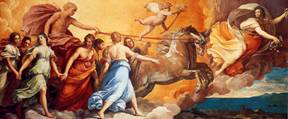
Also on this unique beauty with simulated giallo antico marble inserts. Marked 800 and 117 in lozenge, 16 in powderwell
 ................
An example of giallo antico to right
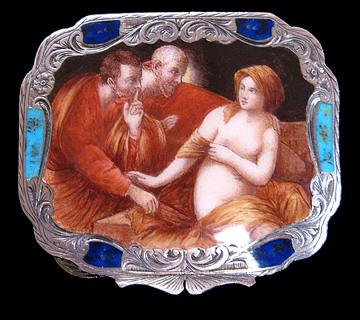
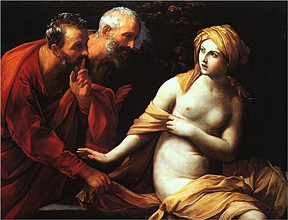
Also by Reni, Susanna and the Elders (1620), marked 800
 ...
...
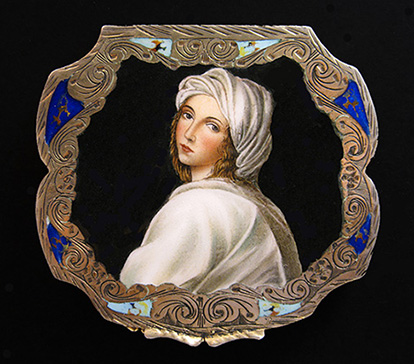
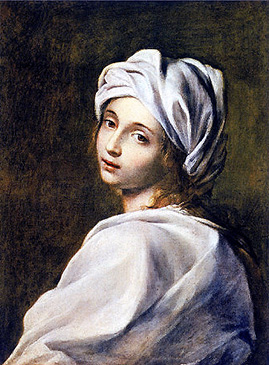
Also by Reni, Portrait of Beatrice Cenci (ca. 1662), marked 800 and 20? in lozenge. This painting has also been attributed to Elisabetta Sirani, a well known Italian Baroque painter and the daughter of Giovani Andrea Sirani, a pupil of Guido Reni.
Beatrice Cenci was executed for the murder of her father by beheading on the 11th September 1599 at the Castel Sant'Angelo in Rome. The tragic story of this young woman inspired generations of artists, writers and musicians. The Cenci was an ancient patrician family who boasted of descending from the Roman gens Cincia. She was the daughter of count Francesco Cenci, one of the wealthiest men of Rome, but his violent and dissolute temperament brought him several times to justice, contributing to his financial and social failure. Due to the frequent financial troubles and, perhaps, in the attempt to avoid the provision of a dowry for Beatrice which could worsen his financial situation, Francesco decided to shut his second wife Lucrezia Petroni and Beatrice in a castle at Petrella Salto in the Cicolano area on the Appennines in 1595, where he also retired himself two years later. Imprisoned by her father, Beatrice plotted to murder him with the complicity of her stepmother Lucrezia, her brothers Giacomo and Bernardo, and several family retainers.After a couple of attempts, on the 9th September 1598 Francesco Cenci was bludgeoned in his sleep by Marzio and Olimpio and then thrown down the stronghold from a walkway, in order to simulate an accident. After her capture and a trial that gained her much sympathy among the people of Rome. she, her stepmother and one of her brothers were executed, with the second brother forced to aid with the executions. Thanks to Milestonerome.com for this information.
 ......
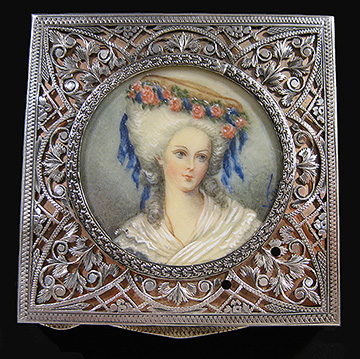
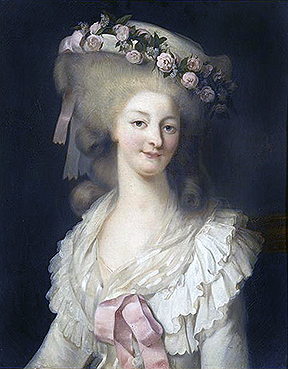
Marie Therese de Savoie, princesse de Lamballe by Louis Edouard Rioult marked 800, 5 in powderwell, illegible in lozenge, signed "Vallesi" lower right. There are two portraits similar to this, one flattering and one not so much. The artist of the flattering one is unknown. I have shown both here.
 .............
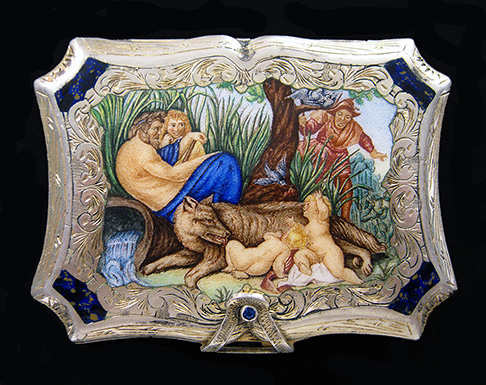
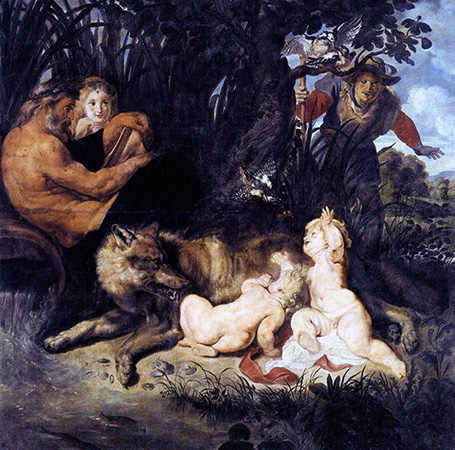
Romulus and Remus by Peter Paul Rubens, Flemish (1615), marked 800 and illegible in lozenge. Romulus and his twin brother Remus were the legendary founders of Rome. Their mother, a Vestal Virgin, explained her pregnancy by claiming she had been violated by Mars, the god of war. She was thrown into prison and the children were ordered to be drowned in the Tiber. They survived and were reared by a she-wolf, and by a woodpecker that watched over them and brought them food. The wolf is seen lying under a tree giving suck to an one infant, while another plays nearby. The herdsman, Faustulus, who discovered them, is approaching. The god of the River Tiber reclines on his urn with the Vestal Virgin at his side.
 .........
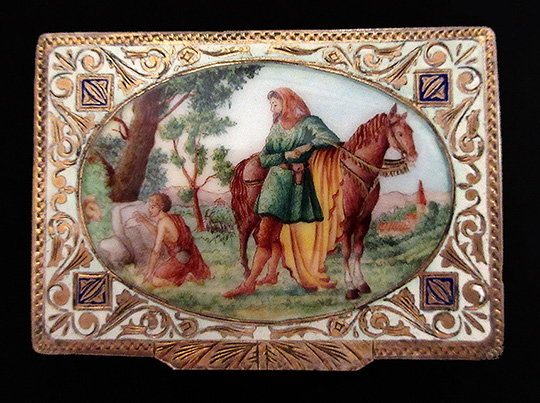
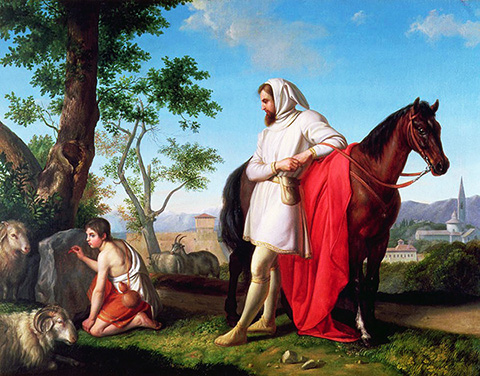
Cimabue Observing the Young Giotto Drawing a Goat on a Rock, by Gaetano Sabatelli, Italian 1846. Marked 800 with swan, illegible in lozenge. Sabatelli (1820-1893) was the son of the Florentine painter Luigi Sabatelli. He maintained a shop and studio in Milan. Very little is known of his life, and this is his most notable and popular work.
 ......
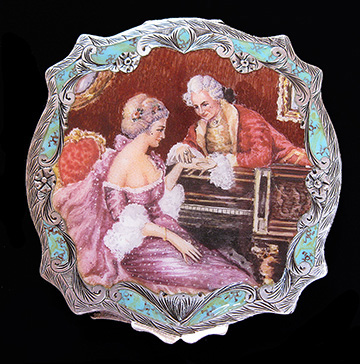
Escena Galante by Juan Pablo Salinas y Teruel , Spanish, ca. 1900. Marked 800 and 220 in lozenge with swan .(Sorry about the size but I have found no other image of this anywhere).
Juan Pablo Salinas y Teruel was born in Madrid, Spain in 1871, and died in Rome, Italy in 1947. He studied painting at the San Fernando School of Fine Art, where a generation earlier Goya had worked. In 1886, he moved to Rome to join his brother Augustin Salinas, and was there since 1883 on a scholarship awarded to him by the government of Saragossa. The two brothers lived in Augustin's studio at Via Margutta in Rome. They became part of the Spanish colony of artists resident in Rome.
 ......
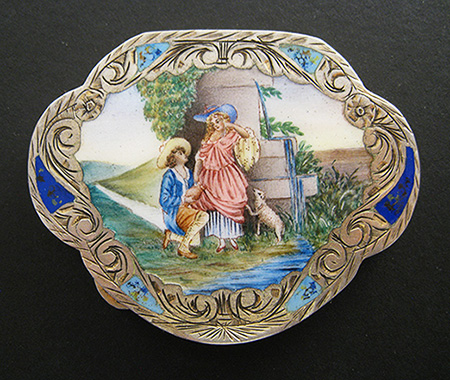
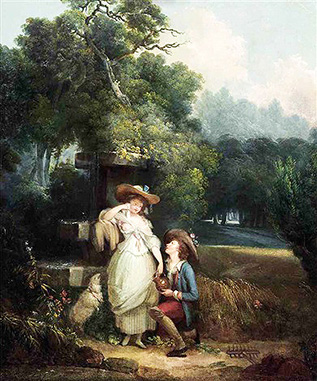
A Shepherd Courting a Shepherdess by a Fountain with a Sheep by Jean Frederic Schall (French, 1800) marked 800, 190 in lozenge and FALLACI FIRENZE
 ...............
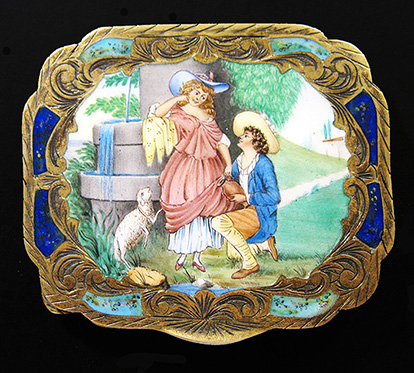
and another marked 800 and 390 in lozenge....
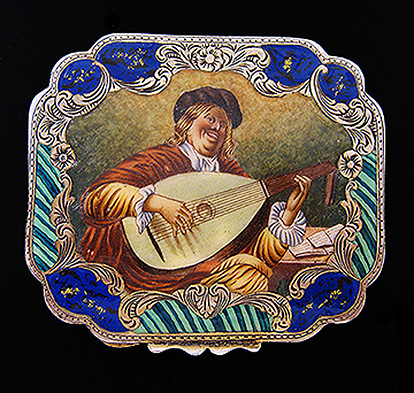
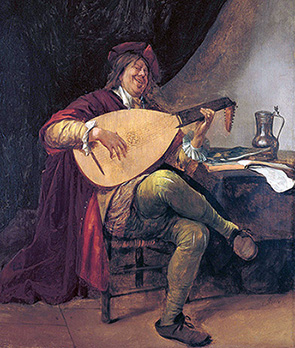
Self Portrait with a Lute by Jan Havickszoon Steen (Dutch Baroque, late 17th century) marked 800 with swan
 .............................
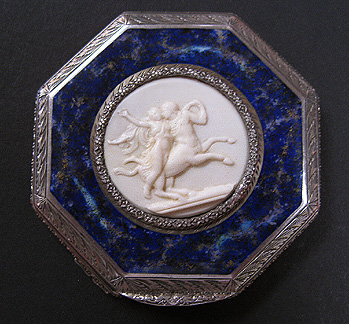
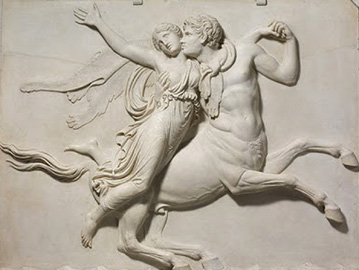
Nessus Abducting Deianira by Bertel Thorvaldsen (Danish, 1768/70–1844) (1814) marked 800, 15 w/fasces in lozenge. This compact has faux lapis enameling, but the central medallion is skillfully carved and shows the striations often seen in ivory, so I believe it is actually ivory. The well-known myth concerns Nessus' betrayal of Hercules' trust: charged with carrying Hercules' wife across the river Euenus, the centaur tries to abduct her but is slain by an arrow. In Greek mythology, Nessus was a famous centaur who was killed by Heracles, and whose tainted blood in turn killed Heracles. Nessus is known for his role in the story of the Tunic of Nessus. After carrying Deianira the wife of Heracles, across the river, he attempted to rape her. Heracles saw this from across a river and shot a poisoned arrow into Nessus's breast. As a final act of malice, Nessus told Deianira, as he lay dying, that his blood would ensure that Heracles would be true to her forever. Deianeira foolishly believed him. Later, when her trust began to wane because of Iole, she spread the centaur's blood on a shirt and gave it to her husband. Heracles went to a gathering of heroes, where his passion got the better of him. Meanwhile, Deianira accidentally spilled a portion of the centaur's blood onto the floor. To her horror, it began to fume by the light of the rising sun. She instantly recognized it as poison and sent her messenger to warn Heracles but it was too late. Heracles lay dying slowly and painfully as the shirt burned his skin—either in actual flames or by the heat of poison. He died a noble death on a funeral pyre of oak branches, and was taken to Mount Olympus and welcomed amongst the gods for his heroic exploits.
Against a severe background, the sculptor chiseled the dramatic moment when Deianira waves to her husband for help as her abductor twists to kiss her. Thorvaldsen's starting point for the composition is an ancient Roman relief that he knew from an engraving now in the Thorvaldsen's Museum in Copenhagen (completed two years after his death to house the works he gave his native city); a series of drawings shows the artist's efforts to intensify the figures' interaction. This particular marble was commissioned by Paolo Marulli, the duke of Ascoli, for his residence in Naples, where it joined other Thorvaldsen reliefs.
 ..........
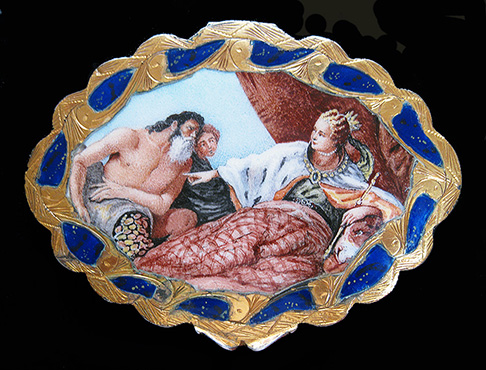
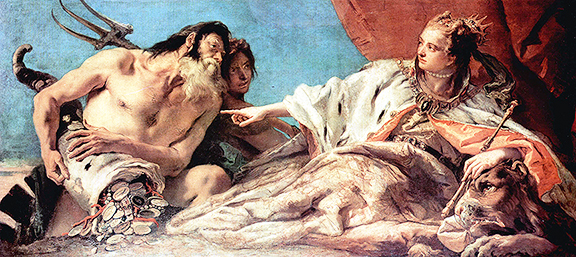
Neptune Offers the Wealth of the Seas to Venice by Giovanni Battista Tiepolo (1748-1750) Venitian Rococo, marked 800 with swan and 220 in lozenge. This painting in the Sala delle Quattro Porte of the Palazzo Ducale in Venice is one of the last public works commissioned by the Venetian Republic. As its thousand years of history drew to a close, the city commissioned this painting of Neptune pouring out the treasures of the sea and the riches of commerce before Venice. The dating is controversial because of the painting's stylistic anomalies. In homage to the context, the work takes up motifs typical of the golden age of Venetian art.
 ..........
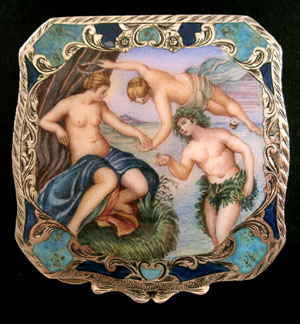
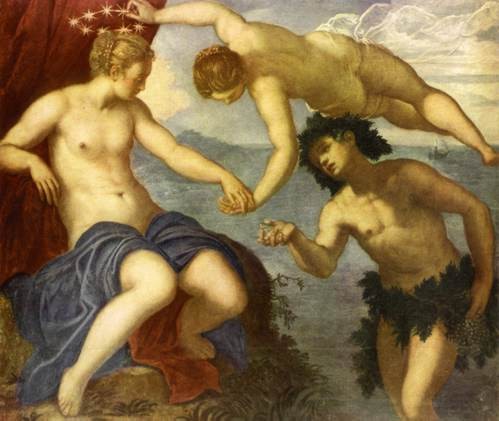
Bacchus and Ariadne by Jacopo Comin (Tintoretto) Italian Renaissance, Venetian School (1577) marked 800, VIIII in powderwell. This painting is in the Ducal Palace of Venice and is from a set of four symbolizing the Venetian State and its government. The subject here is the final triumph of Ariandne, daughter of King Minos of Crete, who had been deserted by Theseus on the island of Naxos after helping him to kill the minotaur and escape from the labyrinth. Ariadne is saved by Bacchus (right) who is adorned with grape leaves as he offers her a wedding ring, and is crowned by Venus, the official priestess of love and marriage. To the Venetians, this scene symbolized the traditional ceremony of the Doge's marriage to the sea,with Ariadne as the symbol of Venice crowned with freedom.
 ......
 .............
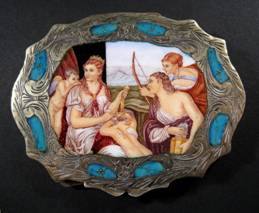
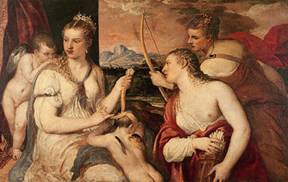
Venus Blindfolding Cupid by Tiziano Vecellio (Titian), Italian Renaissance (1565) marked 800, illegible lozenge w/swan, 10 in powder well …
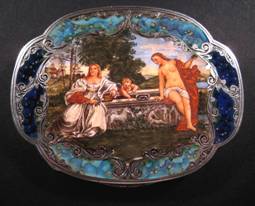
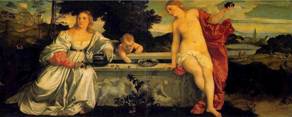
Also by Titian, Sacred and Profane Love (Fleeting and Eternal Happiness) (1514) marked 800, illegible in lozenge. The painting was commissioned by Niccolò Aurelio, a secretary to the Venetian Council of Ten (so identified because his coat of arms appears on the sarcophagus or fountain in the centre of the image) to celebrate his marriage to a young widow, Laura Bagarotto. It depicts the bride dressed in white sitting beside Cupid and being assisted by Venus in person. The figure with the vase of jewels symbolizes "fleeting happiness on earth"; and the one bearing the burning flame of God's love symbolizes "eternal happiness in heaven". The title is the result of a late 18th-century interpretation of the painting, which gives a moralistic reading of the nude figure, whereas the artist intended this to be an exaltation of both earthly and heavenly love. In fact in the Neoplatonic philosophy that Titian and his circle believed in contemplating the beauty of the creation led to an awareness of the divine perfection of the order of the cosmos.
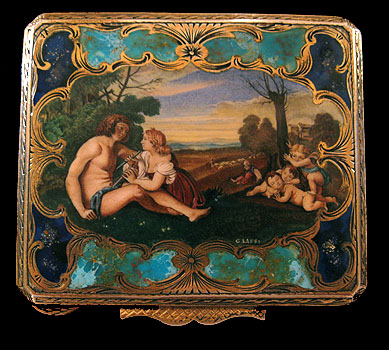
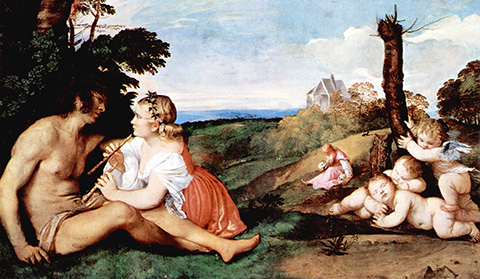
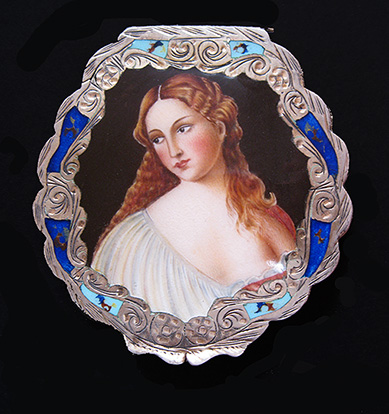
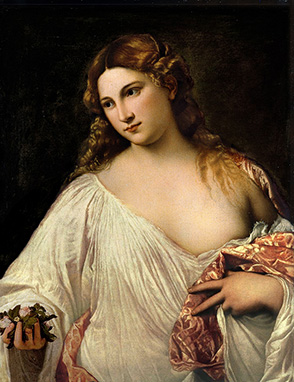
Also by Titian, Flora (1515), marked 800, 198 or 188 in lozenge? The painting portrays an idealized beautiful woman. Her left hands holds a pink-shaded mantle, while another holds a handful of flowers and leaves. The meaning of the painting is disputed: some, basing their ideas on inscriptions added to the 16th century reproductions, identify the woman as a courtesan while others consider it a symbol of nuptial love. The identification with Flora, the ancient goddess of Spring and vegetation, derives from the presence of Spring flowers in her hands.
 ...............
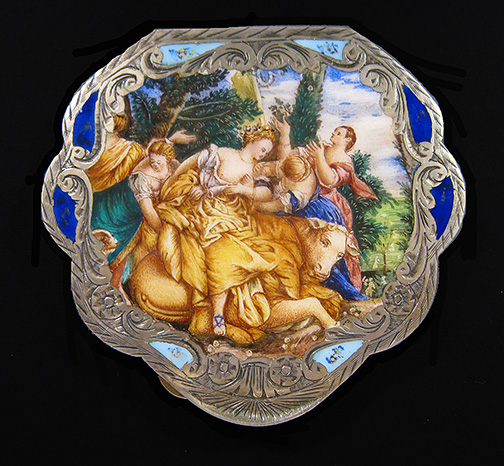
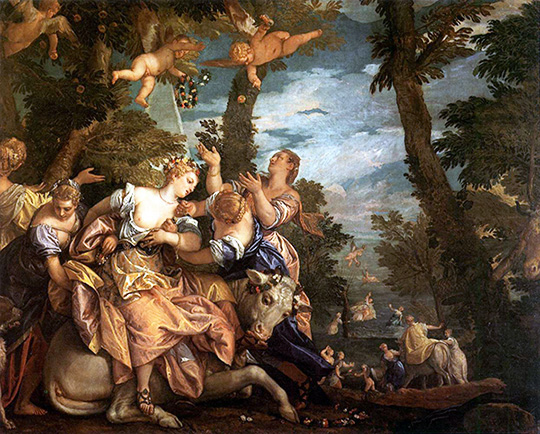
Rape of Europa by Paolo Veronese, Italian Renaissance (1578) marked 800 and 4(?)82 in lozenge. This is one of several versions by Veronese depicting a scene taken from Ovid's 'Metamorphoses', which relates that the princess Europa was carried away from the coastal region of Tyre by the god Zeus in the form of a bull. She sits side-saddleon the bull in the foreground, and is shown again in the lower right corner being carried away toward the sea .
 .....
.....
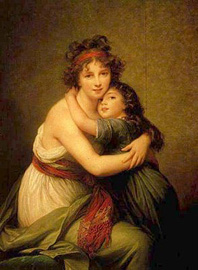
Marie-Louise-Elisabeth Vigée-Lebrun was one of the most famous painters during her time. During her eighty seven-years (1755-1842), she created well over 600 pieces in a time when female painters were rare. Her father, who was also an artist, provided lessons for her in her youth and by the age of fifteen, Vigée-Lebrun had demonstrated such skill that she was able to provide support for herself, her widowed mother, and brother. At the age of twenty her mother pushed her into marrying their landlord, art dealer Jean Baptise Pierre Lebrun. By 1778, she was so well regarded that she was summoned to Versailles to become the official painter to Queen Marie Antoinette. Because they were the same age, they became friends and confidants. Throughout the next ten years, Vigée-Lebrun painted the Queen more than thirty times. In 1783, she was admitted to the French Academy of Arts, which was a great accomplishment because most women at the time were denied entry into such prestigeous organizations.During the turmoil of the French Revolution Vegee-Le Brun had to flee France because of her close ties to the Queen. While traveling Europe in exile, she became a member of the Academies of Rome, Florence, Bologna, St. Petersburg, and Berlin. In these European art centers, she painted heads of state and other aristocrats to help support herself and her family. By 1801 she returned to Paris, but because she disliked Parisian social life under Napoleon, she moved to London where she painted pictures of members of the royalty and literary figures like Lord Byron.
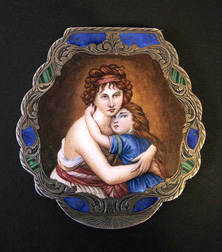 ............
Also by Vigée-Lebrun, Madame Molée-Reymond (1785) marked 800 with 187 or 197 in lozenge
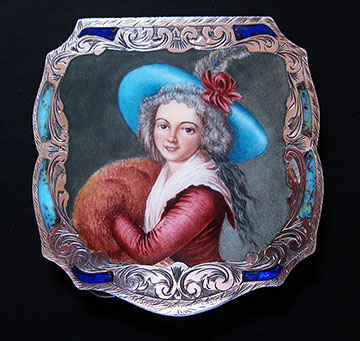 ............
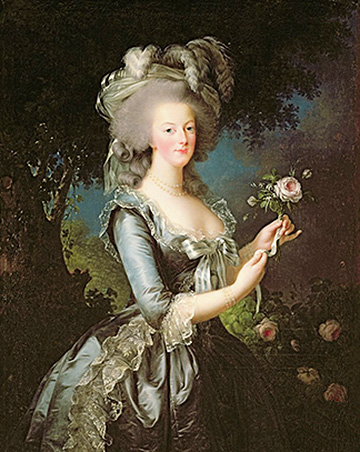
Also by Vigée-LeBrun Portrait of Marie Antoinette (1783) marked 800, Hand Made Italy, 1 in powderwell, 120 in lozenge
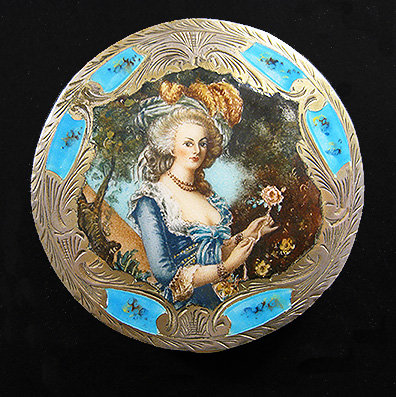 ..............
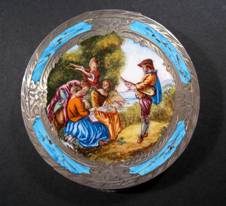
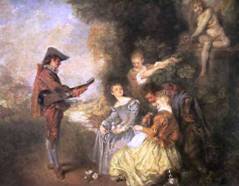
Guitarist and Four Figures Near a Statue by Jean-Antoine Watteau, French Rococo (ca. 1705) marked 800, Coppini, 278 in lozenge, 1 in powder well …
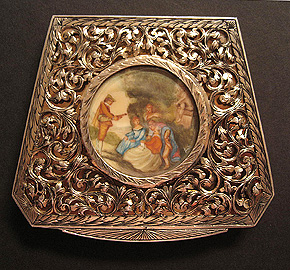
And on this beauty marked 800, illegible in lozenge...
Also by Watteau, Girl with Music Manuscript Book (1726) on a fine F&B tango….
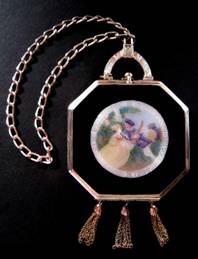
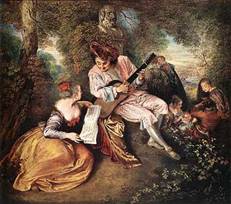
And on this lovely Italian compact, marked 800, 190 in lozenge, 3 in powder well...
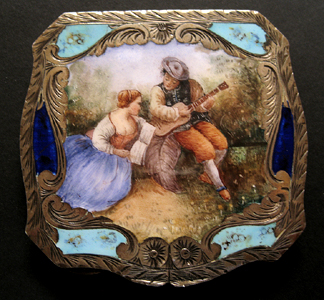
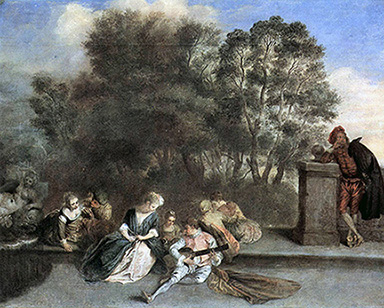
Also by Watteau, a detail from A Guitarist and Seven Figures by a Fountain also known as Italian Recreation (1715), marked only 800
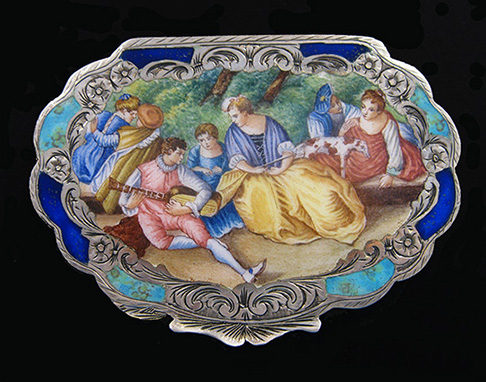 ........
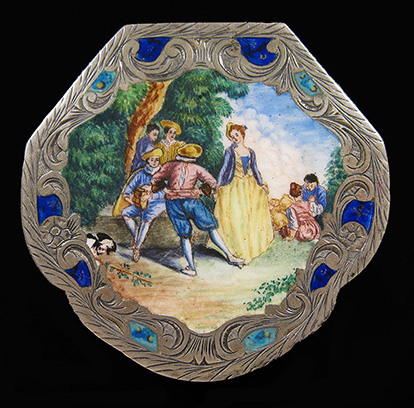
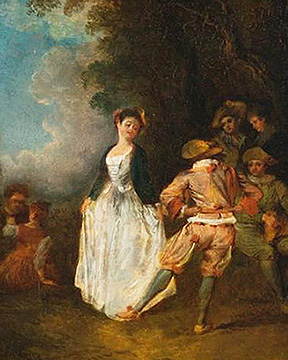
also by Watteau, Danse Paysane (1715), marked 800 and 112 or 117?in lozenge...
 ......
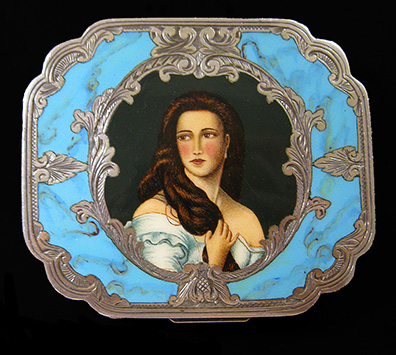
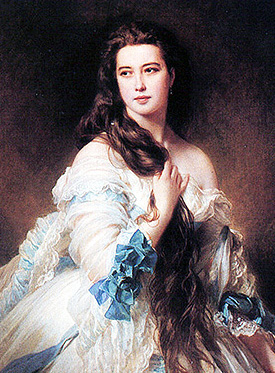
Portrait of Madame Barbe de Rimsky-Korsakov by Franz Xavier Winterhalter (1864) marked 800. Once again, many thanks to Mike Hetherington for this ID.
 .............
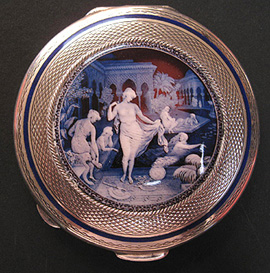 ..................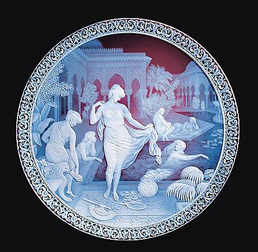
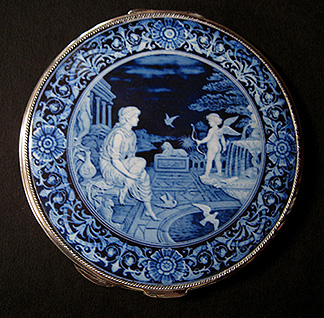
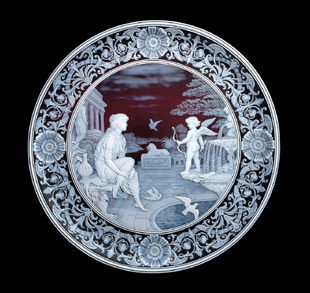
From another cameo plaque also by Woodall, Venus and Cupid (1908) on a fine huge British compact with marks from Birmingham 1932-1933.
 ................
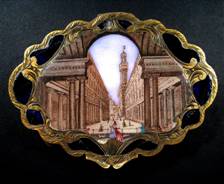
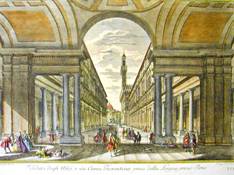
View of the Uffizi by Giuseppe Zocchi, Italian Baroque (1744) marked 800, 220 in lozenge w/swan, 21 in powder well …
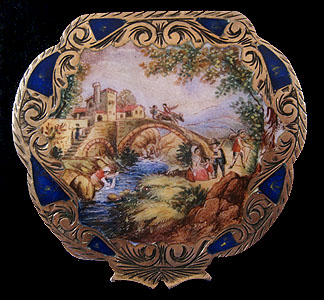
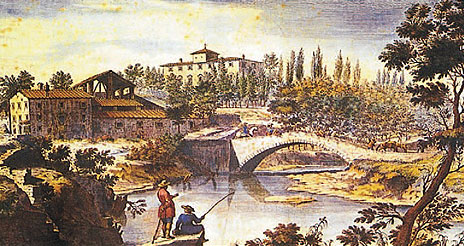
Possibly also by Zocchi is this lovely compact marked 800, Fallaci Firenze, illegible in lozenge, 29 in powder well, with a view of a river, a bridge and a castle with a woman washing clothes in the river and other figures on or near the bridge. It is similar in style to this painting by Zocchi called Villa Castelletti...
 ......
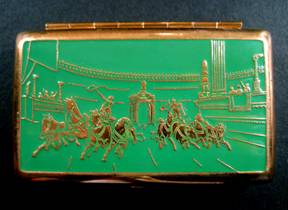
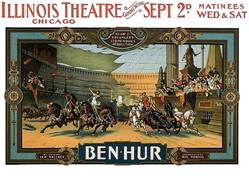
Poster for the Movie Ben Hur by an unknown (1925).This compact is unmarked and was probably sold or given away as a promotion at the opening nightor at theatres where the movie was shown.
 .............
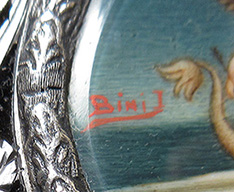
I still have several compacts that I am sure depict
works of art, though I have not been able to find them. Can you help me
identify them?
A few of these are:
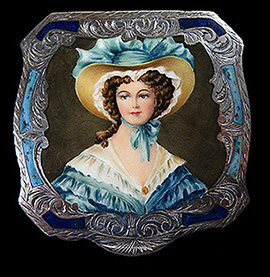
A lovely lady in a blue ribbon bonnet marked 800 and 139 in lozenge
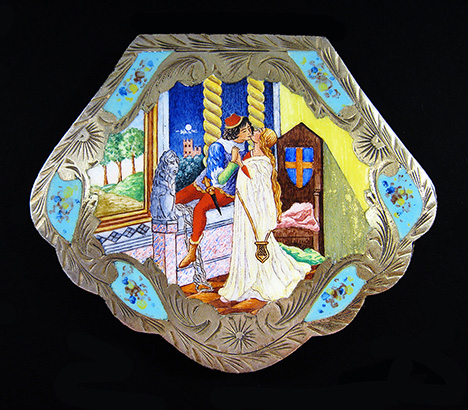
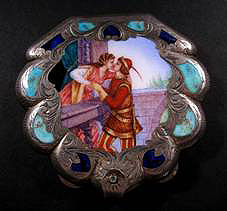
One of the many images of the Romeo and Juliet story, but who was the painter? Marked 800 and 304 in lozenge
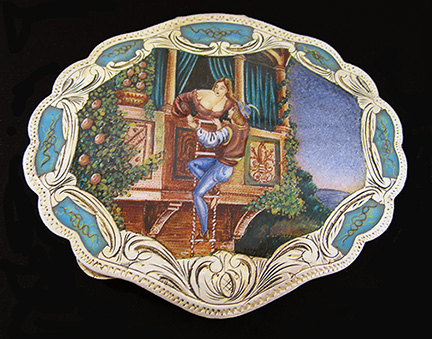
And another marked only 800...
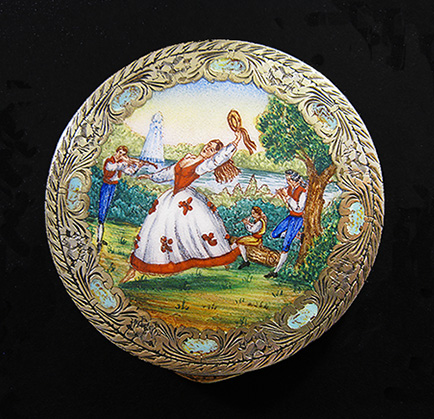
A gypsy dancing in a dress with red bows and a tambourine, marked 800, 6 2 in powderwell, 304 in lozenge
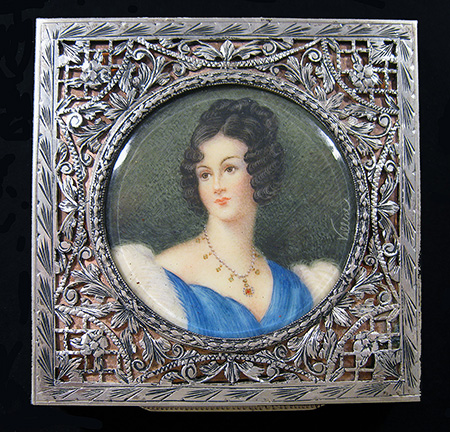
An elegant lady marked 800, 223 in lozenge and signed "Vallesi" to the right...
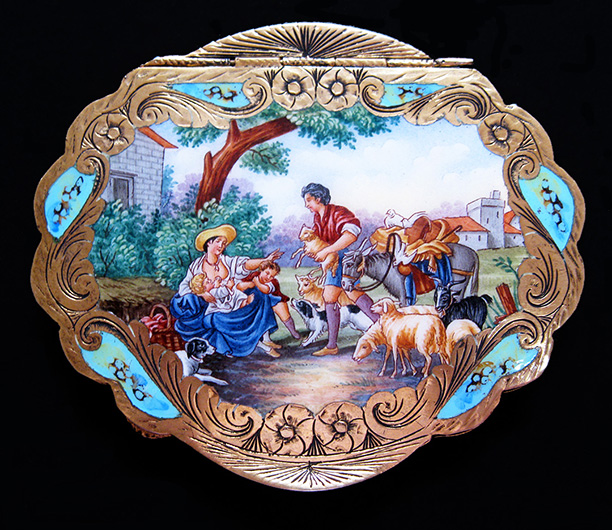
Mother, child, animals and shepherd with animals, marked 800, illegible in lozenge
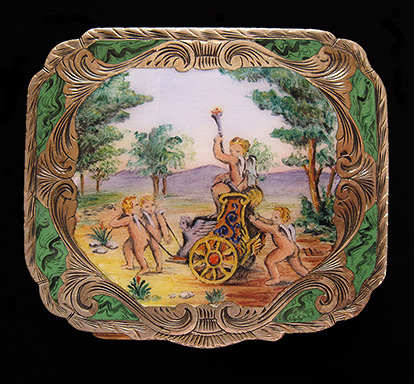
An unusual one - Putti pulling and pushing a chariot with sphinxes while another is in it holding a torch. Marked 800 with 117 in lozenge but who painted it?
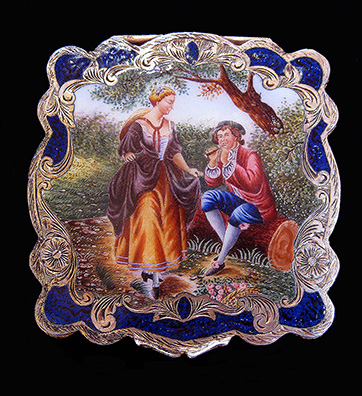
Another mystery - a flautist or piper and a young lady dancing in a landscape - marked 800, illegible in lozenge with a swan- who painted it?
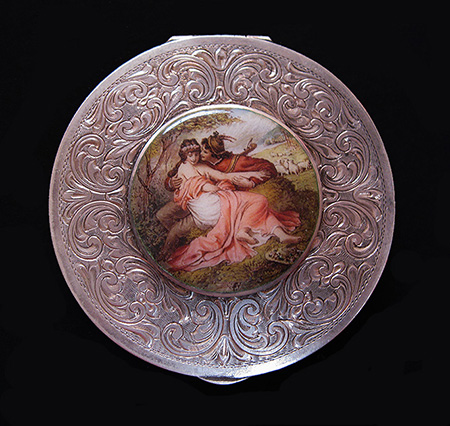
A shepherdess with a Robin Hood-like figure in a landscape on a beautiful 900 Austrian compact marked with a hoopoo and symbols for Vienna- but by whom?
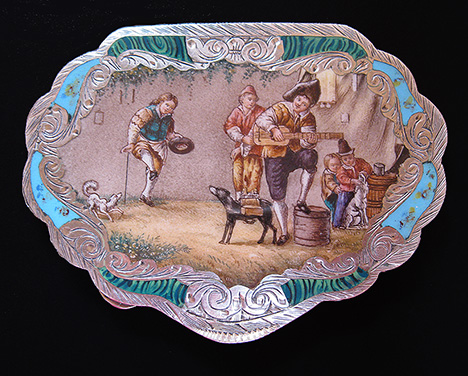
Does this represent peasant dancers in a tavern scene? Or is the man on the left a beggar? Marked 800, 92 w/fasces in the lozenge
Always a popular story, Romeo and Juliet was a famous opera by Charles Gounod in the 19th century. The painting this copies probably dates from that time, perhaps by a Pre-Raphaelite artist…marked 800, 390 in lozenge, 3 in powder well
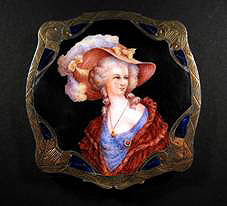
This is certainly a portrait of a well-known lady by an 18th century painter – but who? Possibly Marie Antoinette? Or the notorius Duchess of Devonshire...by Gainsborough? Joshua Reynolds?...marked 800, 220 w/swan, 4C in power well.
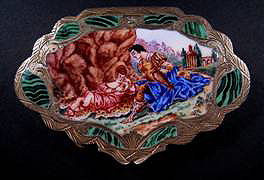
This surely represents Dido and
Aeneas at
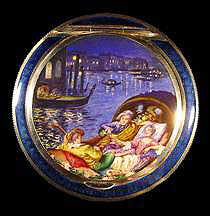
This is a representation of
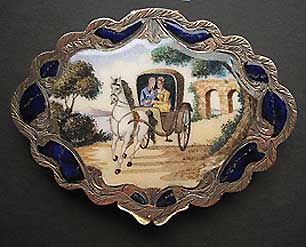
This lovely Italian compact of a coach in the Roman countryside with the ruin of an aqueduct, marked 800, illegible in lozenge w/swan, 13 in powder well, must be from a painting but which one?
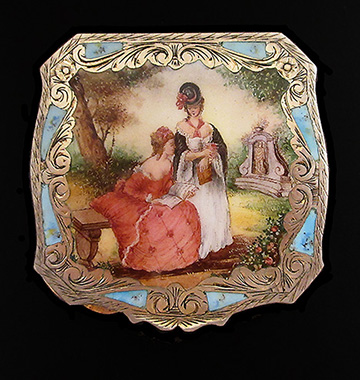
This one reminds me of Jean Baptist Hilaire but what is the painting? Marked 800, "Fallaci" and 390 in lozenge
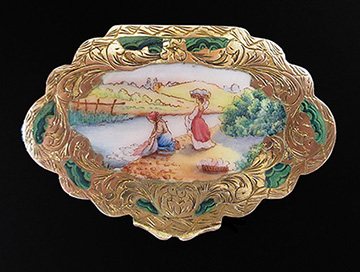
And here are ladies washing clothes in a river, but what is the source of the image? Marked 800 with a swan, illegible in lozenge
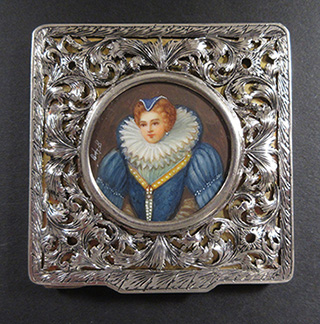
A beautiful Elizabethan or Tudor lady signed RHB? but who did the painting?
A woman awaiting a love letter brought by a bird? Marked 800, illegible in lozenge
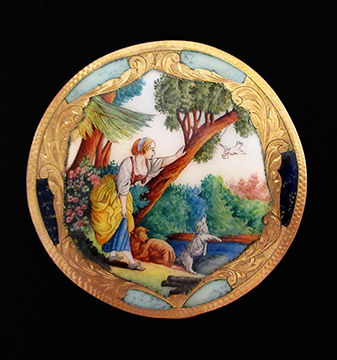
So, many things remain to be discovered and appreciated… What a wonderful hobby!!! If anyone can help me discover the inspirations for these mystery compacts please email me at noellesoren@gmail.com .