
To see the Catalogue of the Collection as of 2004 click here
(For additions to the group of Italian 800 compacts and other compacts depicting works of art see Reflections of Beauty)
SCROLL DOWN BELOW CANES TO SEE MORE RECENT ADDITIONS
Since 2004 I have added a number of cane compacts to my collection...
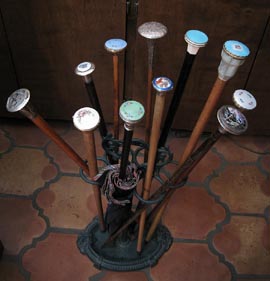
They include (from left):
 ....
....
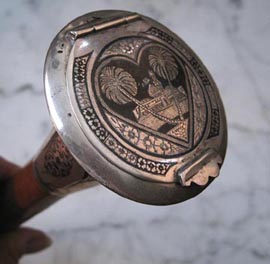
L - Sterling powder compact with a niello scene of a mosque and palm trees by a river...
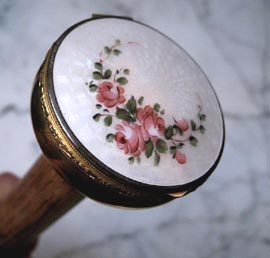
R - Goldtone powder and rouge (probably La Mode ) with guilloché and hand painted roses...
 ...
...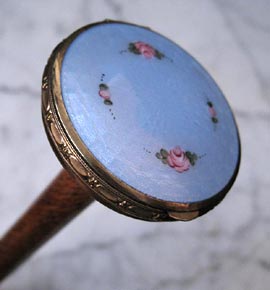
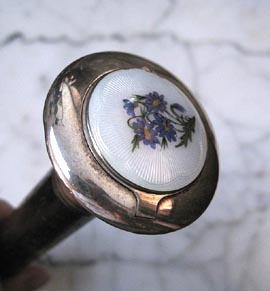
L - Sterling powder compact with white guilloché and hand painted corn flowers...
R - Goldtone powder and rouge (marked "La Mode" with advert for refills from La Mode - Ripley and Gowan inside) with blue guilloché and hand painted roses...
......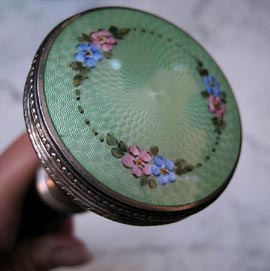 ............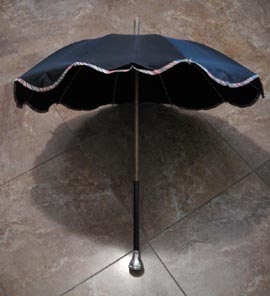
Silvertone powder compact in green guilloché with hand painted roses as the base of an umbrella handle. The compact unscrews and reveals a perfume bottle within the handle...
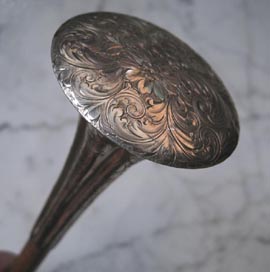 ......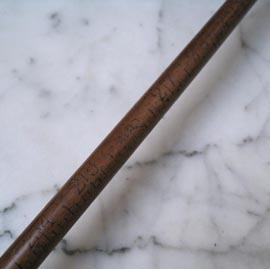
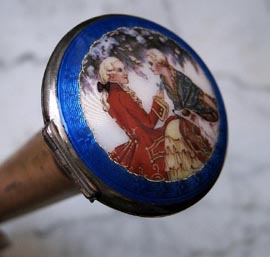
Engraved sterling powder compact (marked "sterling 1907") as head of a 36" yardstick cane...
 ...
...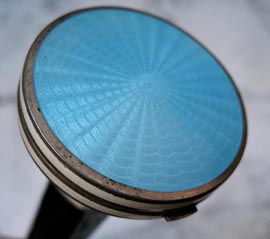
L - Continental sterling (probably Austrian) powder compact with blue and white guilloché and hand painted scene of an 18th century couple in miniature. The entire top is only 1.5" in diameter...
R - Sterling turquoise guilloché and white enamel powder and rouge vanity with an ivory or bone base on an ebony handle...
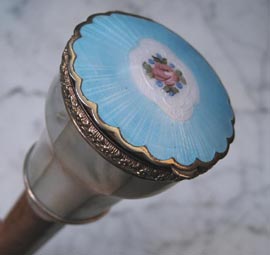 ............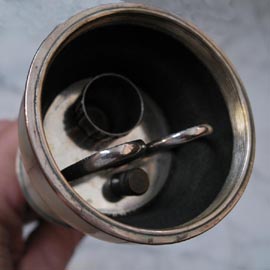
Goldtone turquoise and white guilloché powder and rouge (probably La Mode) on a mother-of-pearl base. The compact unscrews to reveal a sewing kit with thimble, scissors and needle case fitted into holes...
 ...
...
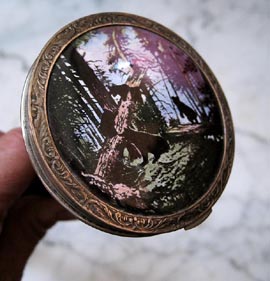
L - Silver (875) Russian powder compact (Russian marks) with painted scene of bears in the woods...
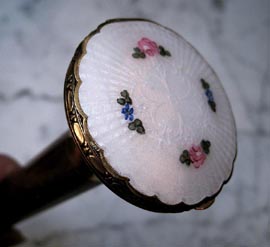
R - Goldtone powder and rouge compact (marked "La Mode") with white guilloché and hand painted flowers...
Other additions to the collection:
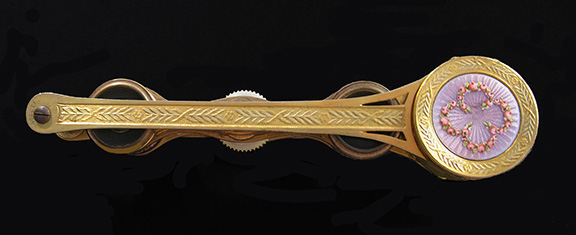 .......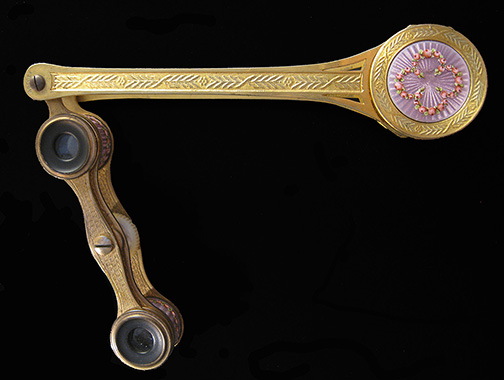
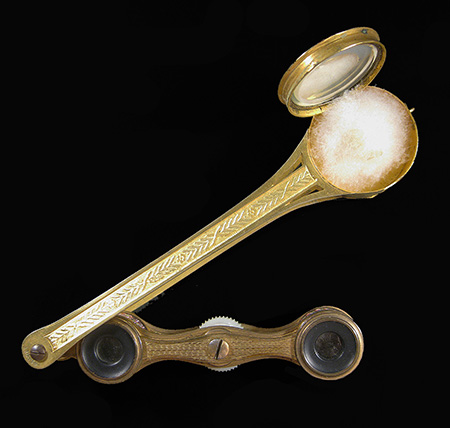
Amazing compact-lorgnette by Asprey of London. The lorgnette is fully adjustable.
Asprey International Limited formerly Asprey & Garrard Limited, formerly Asprey, is a United Kingdom-based designer, manufacturer and retailer of jewelry, silverware, home goods, leather goods, timepieces, polo equipment, and a retailer of books.
Asprey's flagship retail store is located on New Bond Street in London, United Kingdom. Asprey has supplied crows, coronets and sceptres for royal families around the world and as of 2013 held a Royal Warrant appointment from the Prince of Wales. Asprey was established in England in Mitchum, Surrey in 1781. Founded as a silk printing business by William Asprey, it soon became a luxury emporium. In 1841, William Asprey's elder son Charles went into partnership with a stationer located on London's Bond Street. In 1847 the family broke with this partner and moved into 167 New Bond Street the premises Asprey occupies today. From its central London location Asprey advertised 'articles of exclusive design and high quality, whether for personal adornment or personal accompaniment and to endow with richness and beauty the table and homes of people of refinement and discernment.' An early speciality was dressing cases for which it won a gold medal at the International Exhibition of 1862 . Also in 1862, Asprey was granted a Royal Warrant by Queen Victoria. The Prince of Wales, later to be crowned Edward VII, granted another Royal Warrant. As the business grew, the company acquired manufacturing facilities and hired silversmiths, goldsmith and jewellers . In the twenties, commissions poured in from around the world, from celebrities like American millionaire J. Pierpont Morgan. Asprey cigarette cases became collectable amongst young sophisticates who delighted in its other modern products, including travel clocks, safety razors and automatic pencil sharpeners and, as we have here, novelty items like this lorgnette-compact.
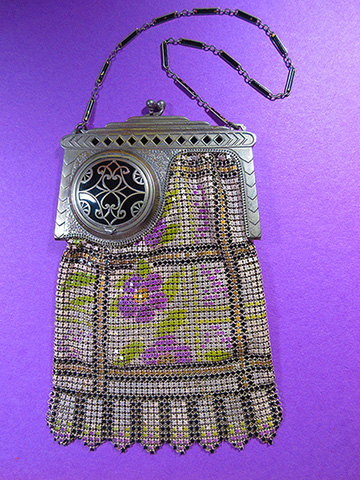
Near-mint, never used Whiting and Davis Mesh compact costume bag featuring Armor mesh, silk lining, enamel frame and chain and enamel decoration of purple flowers and green foliage on a black and gold trellis.
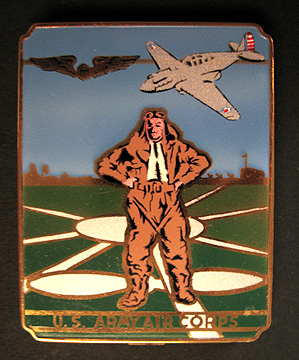
Unmarked U.S. Army AirCorps sweetheart compact vanity
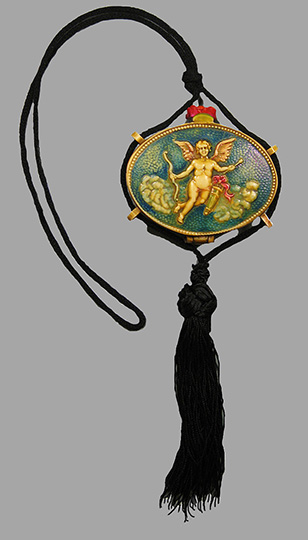
Unusual celluloid vanity depicting cupid with flowers.
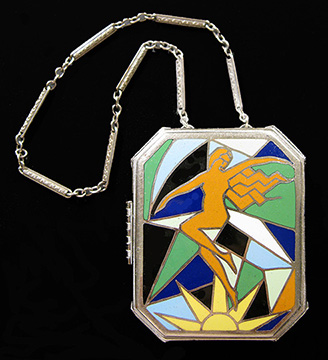
An Art Deco beauty possibly by Fisher with an abstract sunrise.
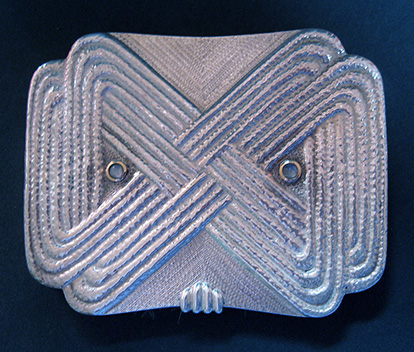
Abstract heavy silver and moonstone compact by the famous Italian jeweler Bulgari (BVLGARI), located in Rome on the Via dei Condotti just a few yards from the Spanish steps. Sotirios Voulgaris, born in an Aromanian village of Kalarites, began his career as a jeweller in his home village of Paramythia, Greece where his first store can still be seen. In 1877, he left for Corfu and then Naples. In 1881 he finally moved to Rome, where in 1884 he founded his company and opened his second shop in Via Sistina. The store in Via Sistina was then replaced by the current flagship store in the Via Dei Condotti opened in 1905 by Bulgari with the help of his two sons, Costantino (1889–1973) and Giorgio (1890–1966)
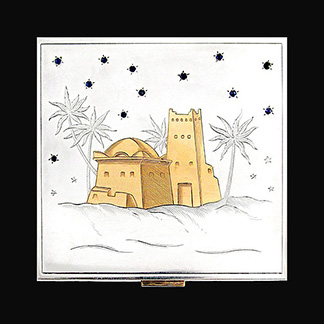
Unusual silver and vermeil compact with sapphire stars depicting a mosque or marabout with French marks, a boars head for 800 silver and a makers mark possibly for Robert Eugene Simon, a Parisian silversmith
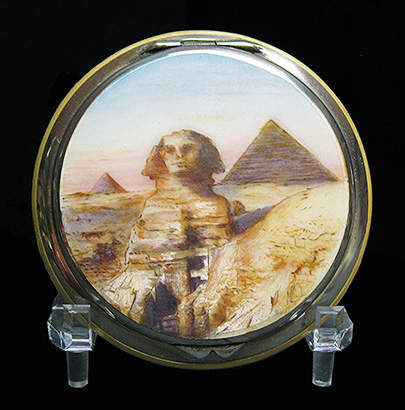
Excellent silver compact marked 935, with a mark indicating import into London. It is probably Austrian. It has a beautiful yellow guilloche back and iridescence in the scene of the sphinx and pyramids on the front.
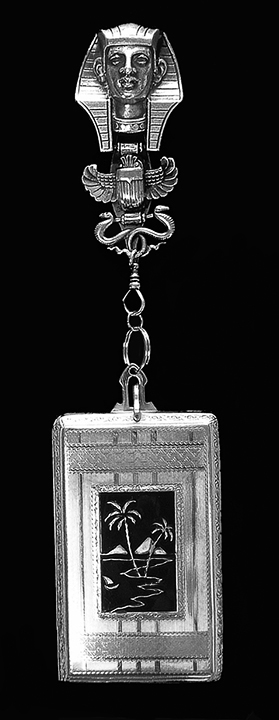
Splendid Egyptian Revival chatelaine with an Evans Egyptian themed vanity
 ....
....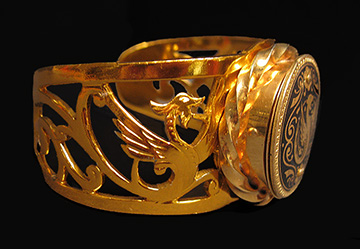
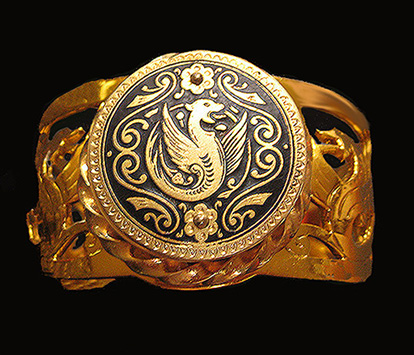
Damascened-inlay style cuff bracelet-compact by Albert Flamand in "Fladium", his own yellow gold version of anodized aluminum. Marked with the"FLAMAND Fladium" trademark, "Made in France Paris" and the signature of Paquita León (see below), it features winged dragons on the compact lid and on the openwork cuff.
In 1930's, Parisian Albert Flamand invented an original and ornamental design for a cuff bracelet. His company, called by his last name FLAMAND, also invented a plating process called "Fladium" with their trademark “FLAMAND Fladium Deposé”. This high quality anodized aluminum was used by the Flamand Company in their jewelry plated with various materials in several colors. Flamand became notable for a series of bracelet-compacts, often with Bakelite accents, inspired and sometimes signed by well-known celebrities of the day, such as French opera star Claudine Cereola (also in this collection, see Compact Catalogue) or this one signed by Paquita León, a Spanish dancer known in Paris as the “Andalusian Flame”. Flamand made several Bakelite bracelets as promotions for films, including one model for the international American-French entertainer-singer-actress Josephine Baker for her great movie, ZOUZOU (also in this collection, see below).
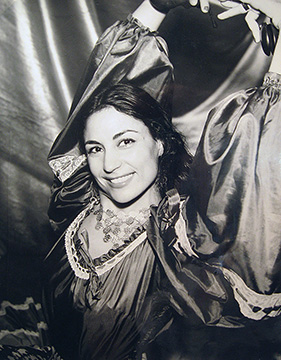
Paquita León in a publicity photo taken in London on October 11, 1942
Little is known of Paquita León except that she appeared in an Argentine musical film in 1936 entitled Radio Bar, and that she was 25 years old in October, 1942 when she appeared as the Star with her troupe of 30 Spanish dancers at the London Casino for a four week season after appearing in Paris where she apparently came to the attention of Albert Flamand.
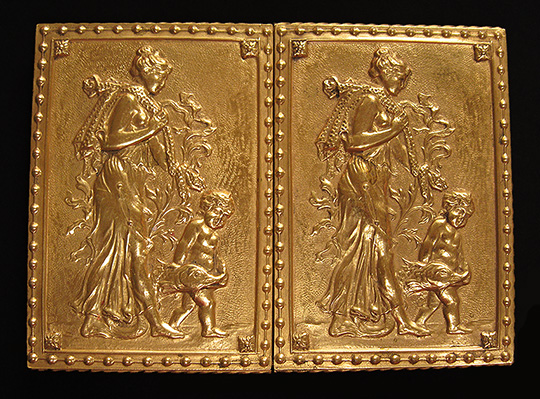
Stunning Italian gold-plated double compact depicting the myth of Leukothea (left with a panther skin over her shoulder) and Palaemon (right accompanied by a dolphin). Palaemon was a young sea god who, with his mother, Leukothea, came to the aid of sailors in distress. He was originally a mortal child named Melikertes whose parents, Ino, daughter of Phoenician Cadmus and Athamas, lord of Boeotia, incurred the wrath of Hera when they fostered the young god, Dionysos. Ino fled with Melikertes in her arms, after Athamas, driven mad by Hera, had killed their other child, and fleeing leapt off the Molurian rocks on the coast of Megara into the sea. Saved by dolphins, the mother and child were transformed into sea-gods and received the names Palaemon and Leukothea. The apotheosis was effected by the Nereides, who saved Melikertes, and also ordered the institution of the Nemean games. The body of Melikertes, according to the common tradition, was washed by the waves, or carried by dolphins into port Schoenus on the Corinthian isthmus, or to that spot on the coast where in later times the altar of Palaemon stood. There the body was found by his uncle Sisyphus, who ordered it to be carried to Corinth, and on the command of the Nereides instituted the Isthmian games. On the isthmus of Corinth there was a temple of Palaemon with statues of Palaemon, Leucothea, and Poseidon; and near the same place was a subterraneous sanctuary, which was believed to contain the remains of Palaemon. In works of art Palaemon is represented as a boy carried by or associated with marine deities or dolphins. Leukothea is often shown with attributes of Dionysos, the child she nurtured, like grapes or, as in this case, panther skins or wild animals.
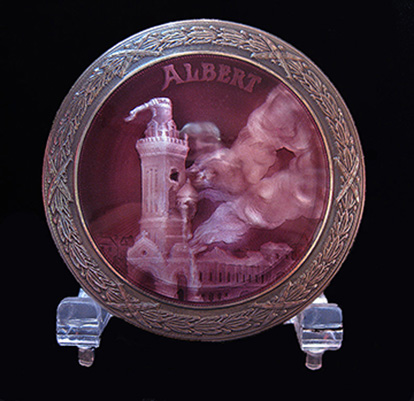
Fine French compact depicting in a mauve cameo-like design under glass the bombing of Albert Cathedral in Albert, France by the British forces in the spring of 1918, during World War I. Albert was the center for the Allies behind the lines but near the Somme battlefields after the British took over the area in 1915. The cathedral was in the center of town, a landmark that, due to its tower and crowning statue, could be seen for miles around and thus provided a target for the enemy. The statue was toppled early in the war but hung precipitously and was stabilized in that position by the French in 1915. When the Germans advanced in the Spring of 1918 it was the British that targeted the cathedral, realizing that the tower could be used as an observation point by the enemy if the German offensive was successful. The Germans were successful, but the town was retaken by the British four months later. Later, the cathedral and statue were fully rebuilt in their original form and still stand today. The compact has the French boar's head mark for 800 silver and the makers mark CB over olive branches, possibly for Charles Brunner.
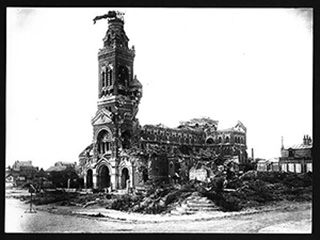 .......................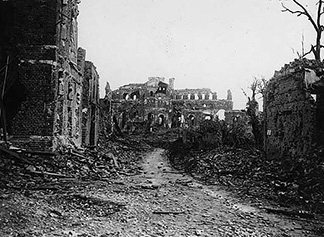
One the left, the cathedral between 1915-1918 (photo by Ernest Brooks). On the right, the cathedral in 1918 after its destruction(photo by John Warwick Brooke)
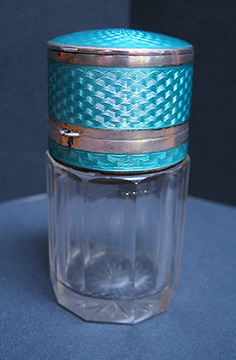 ....................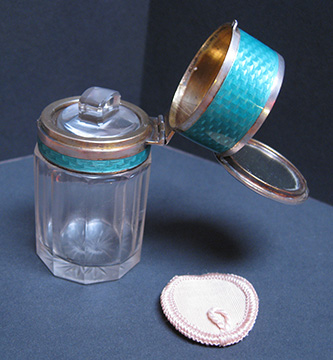
Rare combination compact and scent/smelling salts/pill bottle in sterling with turquoise guilloche, marked as an import to London, 1932. This was probably made in Austria.
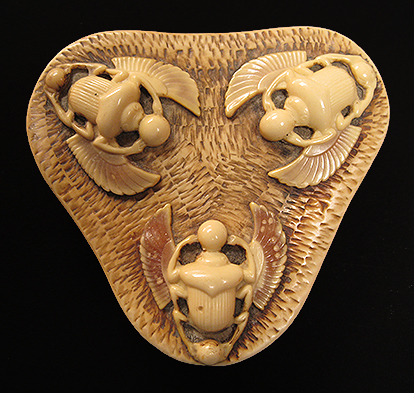
Interesting celluloid compact box with Egyptian scarab figures on lid. Inside are a lipstick, mirror and a powder well.
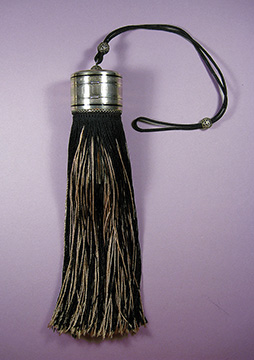
F & B sterling 3-part dance vanity (powder, rouge, cigarette case) with fringe and a lavender guilloche lid...
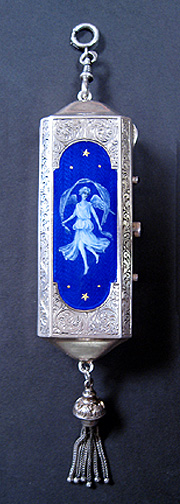 ...
...
Continental sterling vanity and aide-memoire depicting Nyx, Goddess of Night in painting on guilloché surrounded by stars in gold. She is always shown with a drape as in this example from the Paris Psaulter (10th c) and often also with wings.
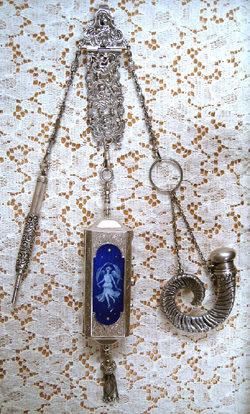
The same on an 18th century sterling French chatelaine with a sterling pencil and a sterling vinaigrette/perfume/snuff container in the shape of a ram's horn
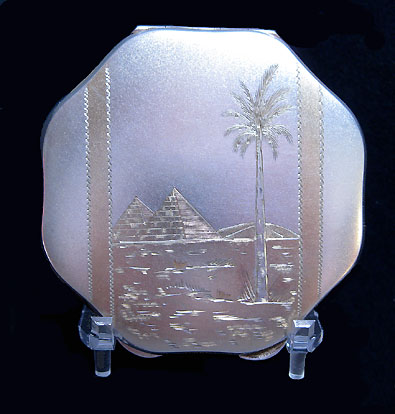
Fine sterling compact marked 835S, cm
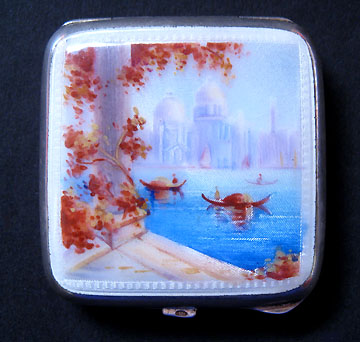
Sterling guilloche compact with scenic view of Venice in the spirit of Thomas Moran, marked 925,continental imported into London
 .....
.....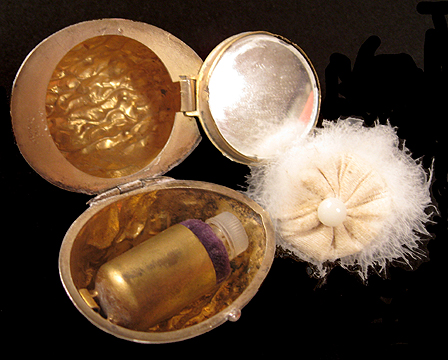
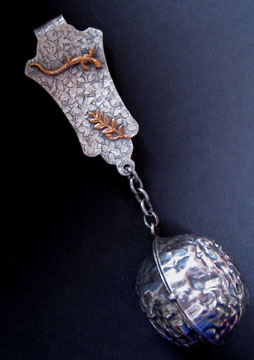
Sterling walnut compact on an interesting woodland theme chatelaine. The chatelaine is marked D&H (Dominick and Haff) 1879 Sterling and the compact is marked 925 Sterling.
 .....
.....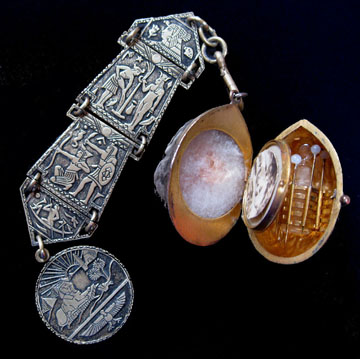
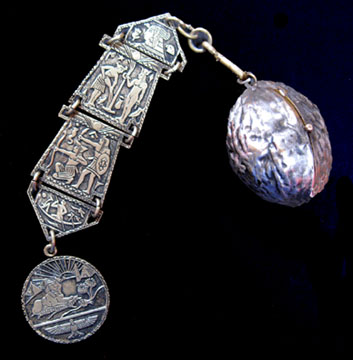
Unmarked brass walnut compact with tiny perfume bottle and pin holder on an Egyptian themed chatelaine
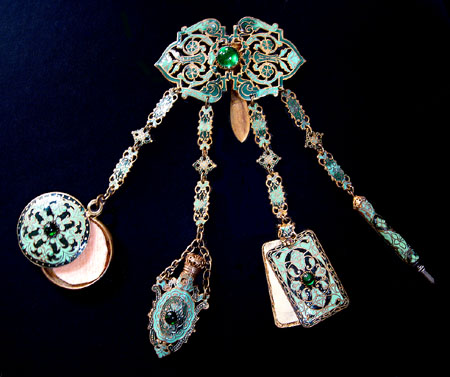
Pristine green jeweled and enameled dance chatelaine with compact, perfume, aide-memoire and pen
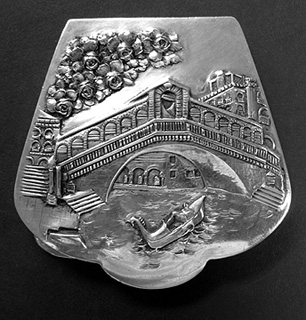
Exceptional Italian 800 compact engraved with a scene of Venice...
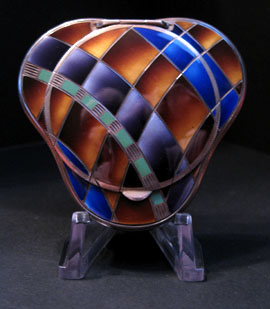
Exceptional sterling (935) compact from Austria with Deco geometrics
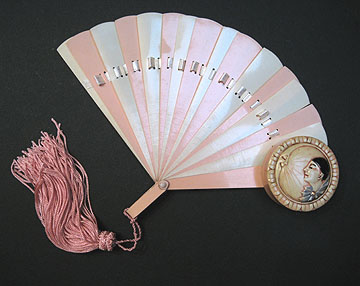
Unusual celluloid fan with attached compact featuring a Pierrot motif
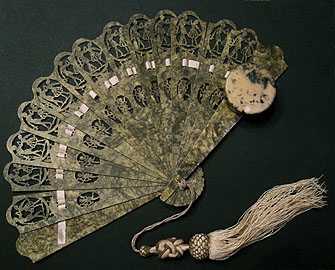 ...........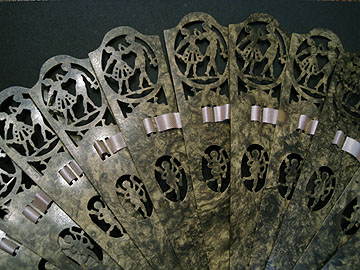
Unusual celluloid fan with cut-out decoration of dancers and cupids and attached compact
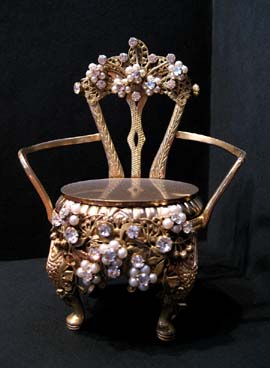
Chair compact marked "Original by Robert" and "Fabulous Boutique Originals by Robert"...
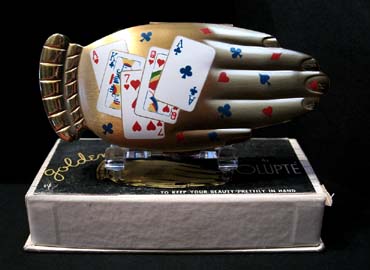
Golden Gesture with playing card motif by Volupte...
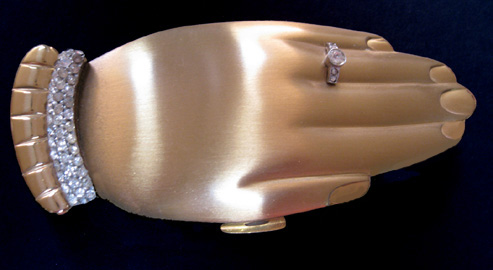
Golden Gesture with a rhinestone bracelet and ring...
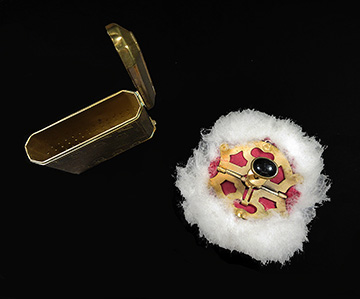
Collapsible pli with case marked "Supra Paris Bte S.G.D.G." ...
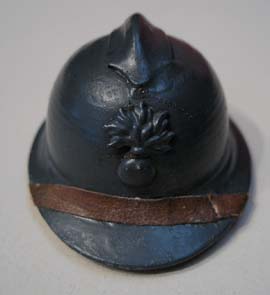
WWI helmet compact...
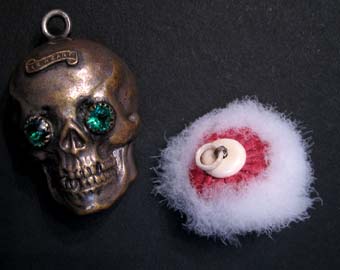
Tiny (1.75" with loop) skull compact, likely from a chatelain, marked "Le Neant" (nothingness, emptiness)...
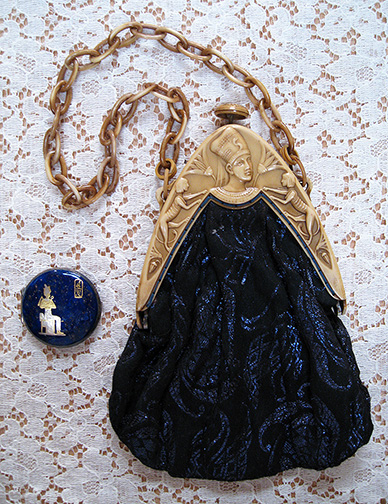 .........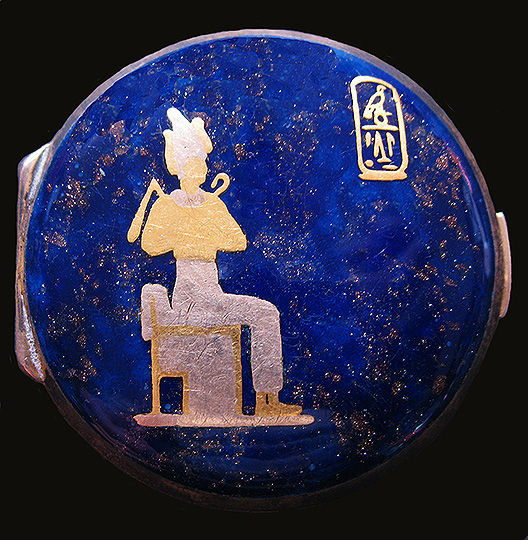
Sterling compact with Egyptian motif with lid and base made from solid pieces of gold flecked lapis lazuli paired with a French Egyptian Revival purse...
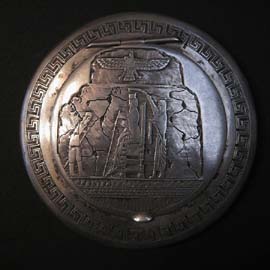
Silver (Arabic script marks) large pancake with symbols and scenes front and back of ancient Persepolis (now in Iran), the ancient Persian capital...
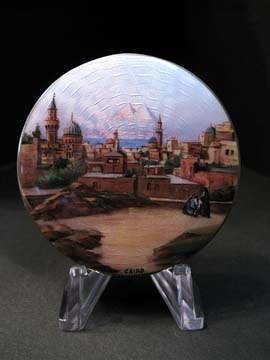
Sterling (marked "925" with British marks) with guilloché and painted scene of the pyramids at Giza from the Mohammed Ali Mosque in Cairo...
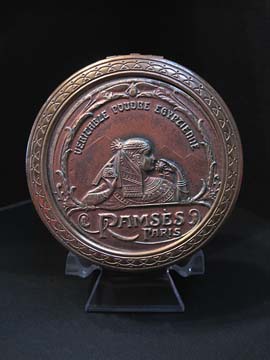
Ramses (Paris) vanity with swing-out powder well and rouge well beneath...
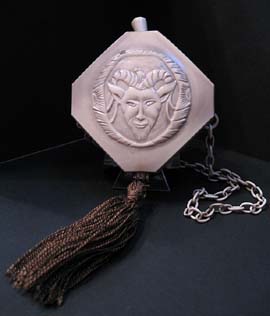
Tango compact in bone or ivory with image of ram with a human face...
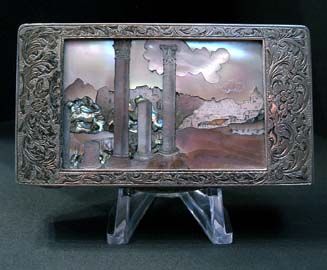
Sterling vanity, marked "Made in Austria" with a view towards St. Peters from the Roman Forum done in intarsia with various colors of mother-of-pearl...
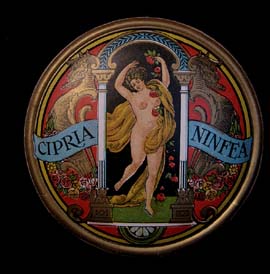
Cardboard powder box with decoration inspired by ancient Roman painting...
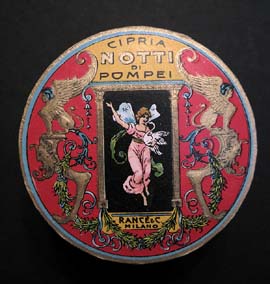
Cardboard powder box with ornate decoration depicting the goddess Psyche inspired by Pompeiian wall painting...
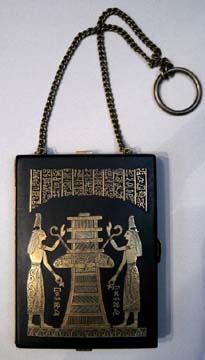
Brass nécessaire with dark brown niello-like finish and Egyptian motives inside and out...
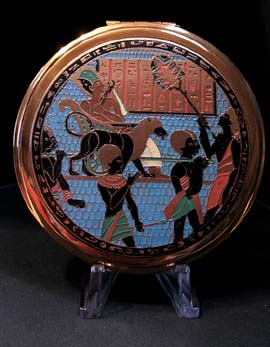
Powder compact marked "VANUDIER Industria Argentina" with Egyptian motif in cloisonné...
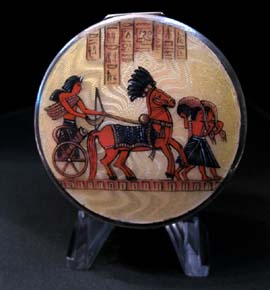
Sterling (British marks) and guilloché powder compact with painted Egyptian inspired scene...
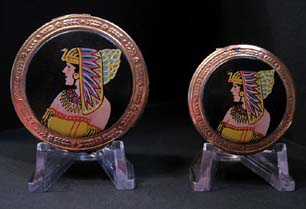
Brass compact and rouge with Egyptian motif, probably DEERE by Reich-Ashe...
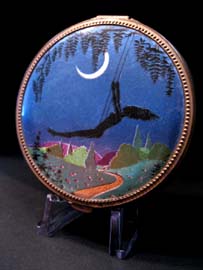
Powder compact with Femme on a swing motif in Deco colors, leather base...
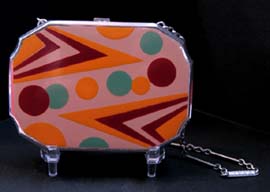
Silvertone tango vanity with Deco enamel motif marked "E.A.M. Elginite"...
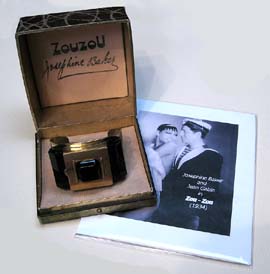
Brass and bakelite "Zou Zou" bracelet compact by Flamande signed Josephine Baker on original box. In 1924 Ms. Baker starred in "Zou Zou" with Jean Gabin. Flamande was a company known for bracelet compacts inspired (or possibly designed) by various artists of the day.
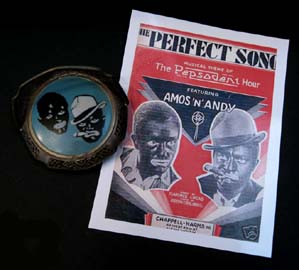
Brass "whoopee" vanity with image of Amos and Andy as seen on the sheet music for "The Perfect Song" the theme song of their famous radio show (1928-1953).
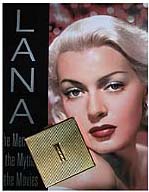
Brass compact by Evans documented from the estate of Lana Turner, engraved "LANA" on the front
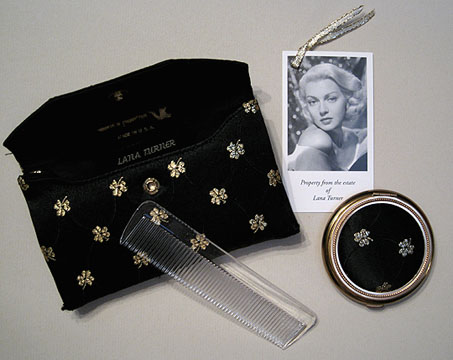
Evening set in black satin with gold embroidery by Lin Bren with compact and comb and name plate reading "Lana Turner". Documented from the estate of Lana Turner.
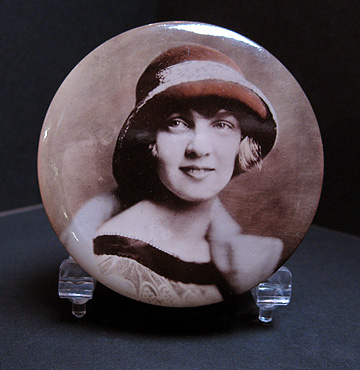
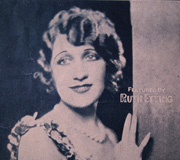 ..............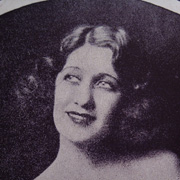
Ruth Etting
Screw-top compact with portrait. No Marks.
Ruth Etting
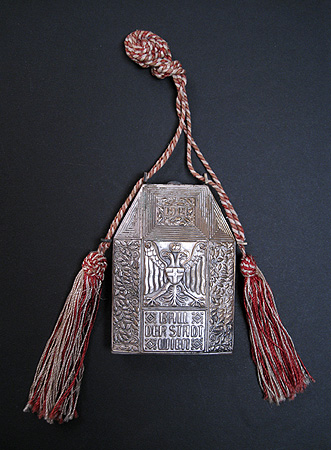 ....................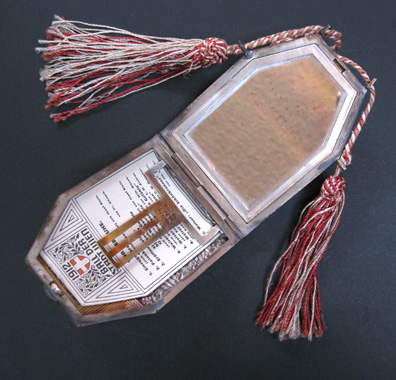
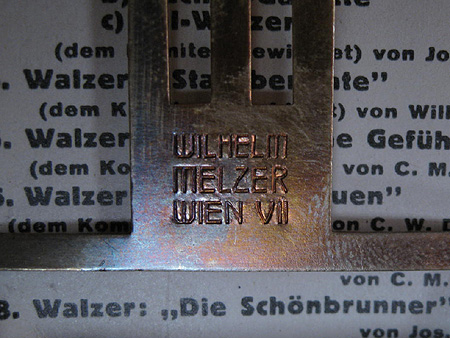
Vienna State Ball Souvenir Dance Compact/Program (1912) by Wilhelm Melzer (marked “Wilhelm Melzer Wien VII”).Since it includes a mirror (for primping?) I consider it to be a compact. It also includes a program of the music played that night at the ball.
Wilhelm Melzer was an artist in book binding and metal work with the Wiener Werkstätte (Vienna Workshops) at the beginning of the 20 th century in Vienna , Austria . This group evolved from the Vienna Secession, founded in 1897 as a progressive alliance of artists and designers. From the start, the Secession had placed special emphasis on the applied arts, and its 1900 exhibition surveying the work of contemporary European design workshops prompted the young architect Josef Hoffmann and his artist friend Koloman Moser to consider establishing a similar enterprise in Austria . Finally in 1903, with backing from the industrialist Fritz Wärndorfer, the Wiener Werkstätte was born. From three small rooms, it soon expanded to fill a three-story building with separate, specially designed facilities for metalwork, leatherwork, bookbinding, woodworking and a paint shop. Later furniture making, jewelry making and textile weaving were included as well. The group had a clear aim: to make all facets of human life into one unified work of art. This included the creation of advanced working conditions for the craftsmen, and the philosophy that everything, utilitarian objects as well as decorative objects, should be created entirely anew. The aim of the group was to create objects of outstanding individuality and beauty, and great value was put on originality and exquisite craftsmanship. This idea was reflected in the organisation's motto: "Better to work 10 days on one product than to manufacture 10 products in one day." The group eventually opened workshops in many European countries as well as in the United States . Some famous names associated with this movement in addition to Josef Hoffmann include Gustav Klimt, Oskar Kokoschka, Maz Kurzweil, Egon Schiele, Mathilde Flögl, Lotte Föchler-Frömmel and Dagobert Peche, among many. Melzer is mentioned in Joann Skrypzak, Design Vienna - 1890s to 1930s. Elvehjem Museum of Art, University of Wisconsin-Madison, 2003.
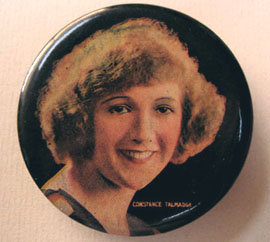 ........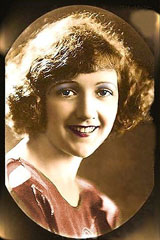
Screw-top compact marked "Parisian Novelty Company Chicago" with a photo of movie star Constance Talmadge. Talmadge was born on April 19, 1898 in Brooklyn, New York into a poor family. Her father, Fred, was an alcoholic and left them when she was still very young. Her mother, Peg promoted Norma as a model for title slides in flickers , which were shown in early nickelodeons. This led Connie, as well as her two sisters, Norma and Natalie, into an acting career. She began making films in 1914, in a Vitagraph comedy short, In Bridal Attire (1914). Her first major role was as The Mountain Girl and Marguerite de Valois in D.W. Griffith's Intolerance (1916). Her friend Anita Loos, who wrote many screenplays for her, appreciated her "humour and her irresponsible way of life". Over the course of her career, Talmadge appeared in more than 80 films, often in comedies like A Pair of Silk Stockings (1918), Happiness à la Mode (1919), Romance and Arabella (1919), Wedding Bells (1921) and The Primitive Lover (1922). She is quoted, "I enjoy making people laugh. Secondly, because this type of work comes easiest and most naturally to me, I am not a highly emotional type. My sister could cry real tears over two sofa cushions stuffed into a long dress and white lace cap, to look like a dead baby, and she would do it so convincingly that 900 persons out front would weep with her. That is real art, but my kind of talent would lead me to bounce that padded baby up and down on my knee with absurd grimaces that would make the same 900 roar with laughter."With the advent of talkies in 1929, Talmadge left Hollywood. Her sister Norma did make a handful of appearances in talking films, but for the most part the three sisters retired all together, investing in real estate and other business ventures. Only a few of her films survive today. Like her sister Norma, Talmadge succumbed to substance abuse and alcoholism later in life. She also had many failed affairs and relationships.Along with her sister Norma, Mary Pickfordb and Douglas Fairbanks, Talmadge inaugurated the tradition of placing her footprints in cement outside Grauman's Chinese Theatre in Hollywood. She left a trail of five footprints in her slab.Her star on the Hollywood Walk of Fame is at 6300 Hollywood Blvd.
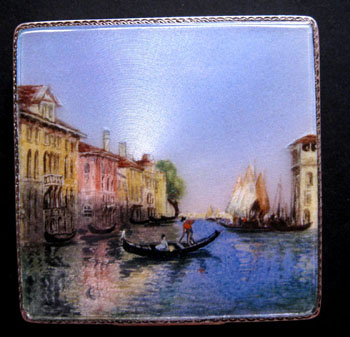
Heavy silver compact marked for London 1913 with painted scene of Venice over a guilloche background.
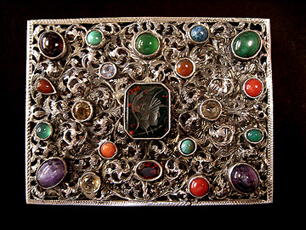
Intricate 800 silver compact, probably Italian, with open scroll work and bloodstone intaglio in the center. The stones include garnets, amethyst, coral, blue topaz, chrysoprase, citrine, carnelian and malachite.
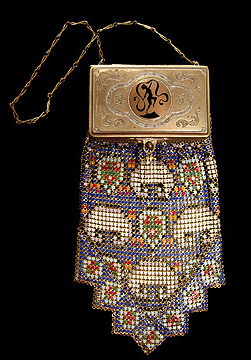
Lovely Whiting and Davis EL-SAH mesh vanity bag in extraordinary condition.
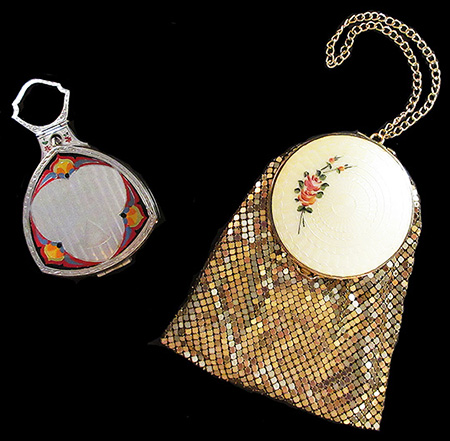
Two lovely Evans examples, notable because my local antique stores never have compacts, but one day these showed up!